Why Your PTZ Camera Needs a Great Brain
The Role of ISP
Every camera has two essential jobs: collecting light and making sense of it. The sensor takes care of the first part, but what it captures is not yet an image—it’s raw, unprocessed, and invisible to the human eye. That’s where the Image Signal Processor (ISP) comes in.
For PTZ cameras, which are often fixed in position yet expected to perform flawlessly across changing lighting conditions, the ISP is the unsung hero behind every frame. It handles everything from noise reduction and white balance to dynamic range and color accuracy, ensuring your footage is clear, natural, and reliable.
In this guide, we’ll dive into how ISPs work inside PTZ cameras, explore the key features that define image quality, and show you what to look for when evaluating one.
What Is an ISP and What Does It Do?
The ISP — Image Signal Processor — is a dedicated processing chip inside the camera that sits between the sensor and the final video output. Its job is to take the raw electrical signals captured by the sensor and convert them into a clean, color-accurate, broadcast-ready image — handling everything from noise reduction and white balance to dynamic range and sharpening, in real time, on every single frame.
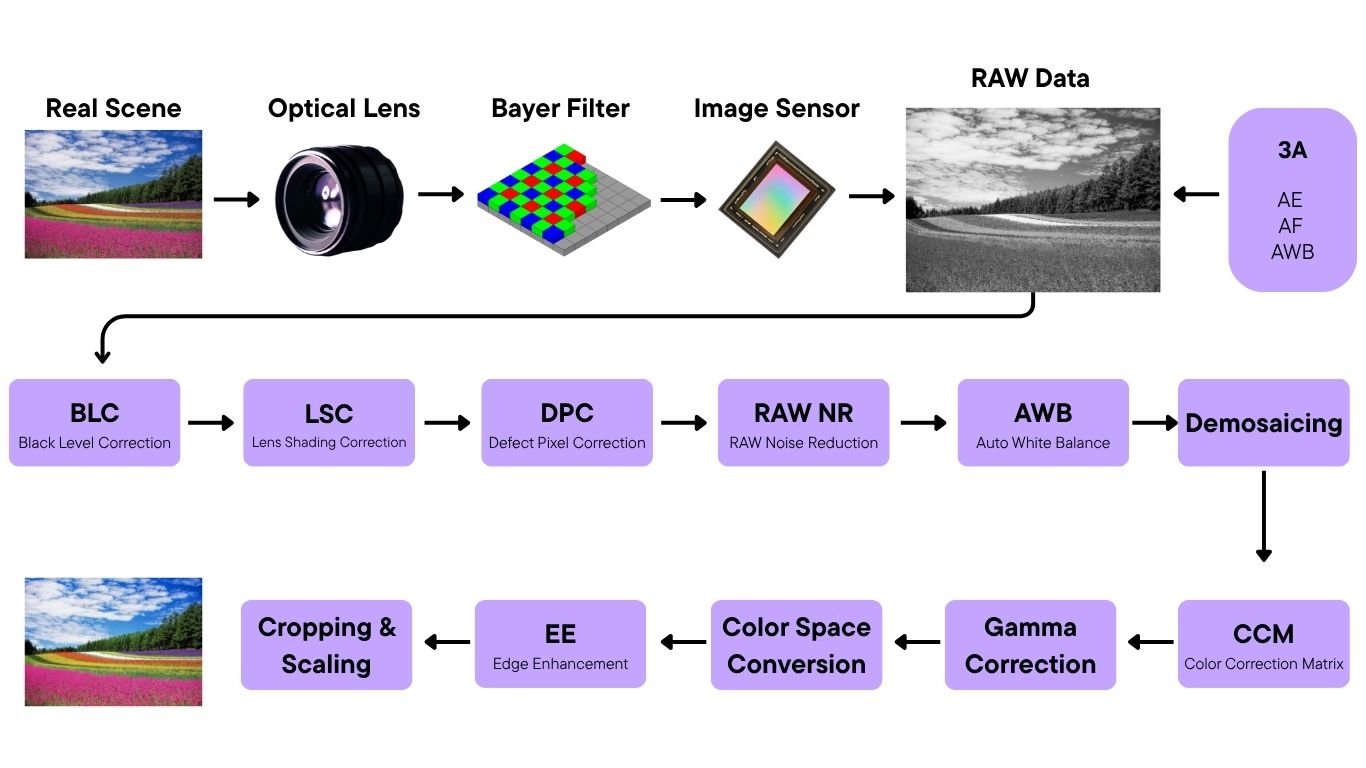
The full ISP pipeline — from raw sensor data to final image output. Each stage refines the image in a different way, and all of it happens in real time, on every frame.
Think of it this way. The sensor is the farmer — gathering raw ingredients from the field. The ISP is the chef — taking those ingredients and turning them into something worth watching. The quality of the final dish depends on both, but it is the ISP that decides how the image looks, how the colors feel, and whether the result is ready to serve.
This is why two PTZ cameras with identical sensor specifications can produce noticeably different images. The sensor determines how much light is captured and at what resolution. The ISP determines how that light is interpreted — how shadows are handled, how colors are rendered, how the camera adapts when conditions shift. A more advanced ISP does not just process faster; it processes smarter, making nuanced decisions automatically to maintain image quality.
For PTZ cameras, the ISP's role is especially significant. Fixed in position and often covering wide, unpredictable environments, PTZ cameras depend on the ISP to maintain consistent image quality as lighting shifts and scene conditions change. In other words, the ISP is not just a processor — it is the brain that allows the camera to think on its own.
How ISP Processes an Image
From Raw Data to Final Output
The raw data coming off a camera sensor is not an image — it is a grid of single-color light measurements that the human eye would not recognize as a picture. The ISP processes this data through a series of steps, each one refining the image in a specific way before it reaches the final output.
Demosaicing
Camera sensors capture each pixel in only one color — red, green, or blue. Demosaicing is the process of interpolating these single-color measurements into full-color pixels, reconstructing the complete image the sensor never actually captured whole. It is the step that turns raw data into something that looks like a photograph.
Noise Reduction
All camera sensors produce a certain amount of noise — random variations in brightness and color that appear as grain, particularly in low-light conditions. The ISP applies noise reduction to clean this up. 2D noise reduction works within a single frame; 3D noise reduction goes further by comparing information across multiple frames, producing cleaner results in dark environments without sacrificing detail.
Auto White Balance
Different light sources — sunlight, tungsten, fluorescent — have different color temperatures, which shift the overall tone of an image toward blue, orange, or green. Auto white balance corrects for this automatically, ensuring that colors — and particularly skin tones — remain accurate and natural regardless of the lighting environment.
Sharpening
Sharpening enhances the definition of edges within the image, making fine details appear crisper and more defined. Applied well, it adds clarity without being visible. Applied too aggressively, it produces unwanted white halos around edges — an artifact that is particularly noticeable on high-contrast boundaries and difficult to correct in post.
Each of these steps happens in sequence, in real time, on every frame the camera produces. The quality of the ISP determines how well each step is executed — and how seamlessly the results hold up under the demands of live broadcast.
ISP Technical Concepts Worth Knowing
Understanding the basics of ISP is enough for most purchasing decisions. But for those who want to go deeper — whether evaluating cameras for a specific deployment or simply curious about what separates good image processing from great — these three concepts are worth understanding in detail.
2D vs 3D Noise Reduction: Why It Matters in Low-Light PTZ Deployment
Every camera sensor produces noise — random variations in brightness and color that appear as grain in the image, most visibly in low-light conditions. The ISP handles this through two distinct approaches.
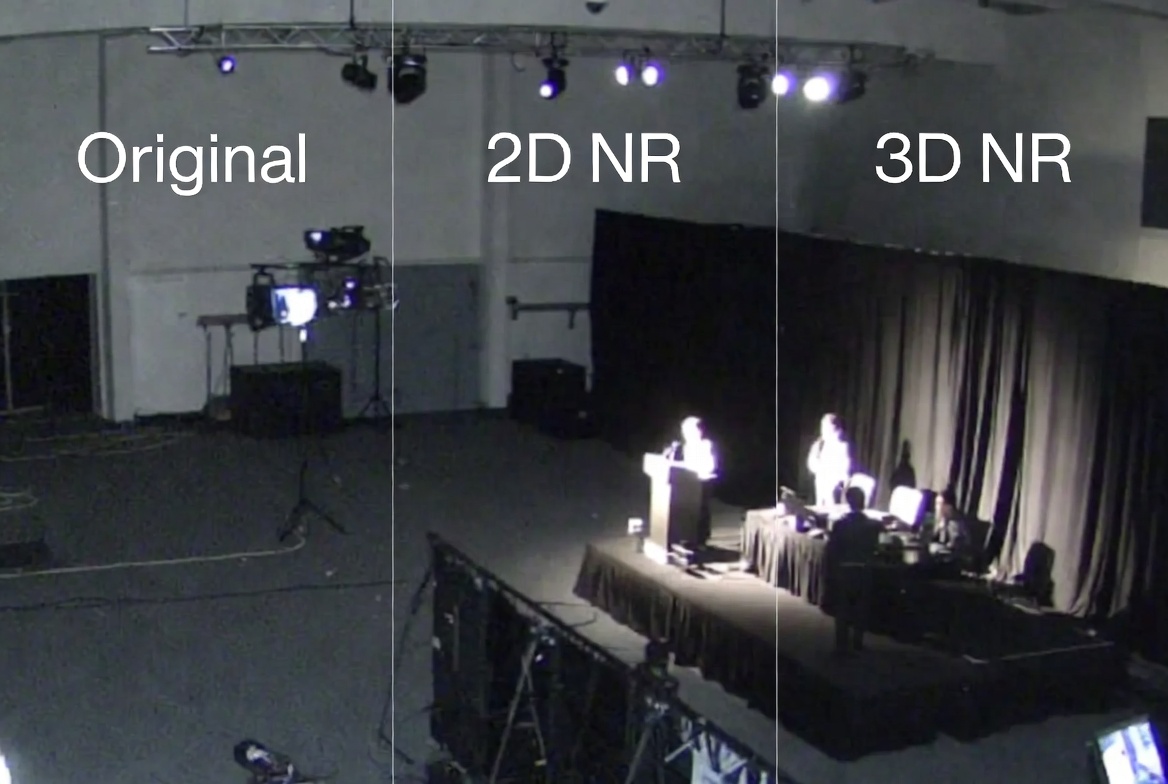
2D noise reduction works within a single frame, analyzing each image independently to smooth out grainy pixels. It is effective in moderately low light, but has a limitation: push it too hard and the image starts to look soft and painted — fine detail is lost along with the grain.
3D noise reduction compares information across multiple consecutive frames. Because genuine image detail stays consistent from frame to frame while noise is random, the ISP can remove noise more precisely without sacrificing detail. In a dimly lit venue or a late-evening outdoor event, the difference is visible — cleaner footage, more natural texture, and finer detail preserved even as light levels drop.
For PTZ cameras deployed in low or variable lighting environments, 3D noise reduction is one of the specifications most worth evaluating closely.
Color Science in PTZ Cameras: More Than Just Accurate Colors
Most people assume the ISP's job is simply to reproduce colors accurately. In practice, it goes further than that — and understanding this explains why cameras from different manufacturers can look noticeably different even under identical conditions.
The Color Correction Matrix (CCM)
The CCM is a set of mathematical parameters built into the ISP that maps the sensor's raw color output to a defined color space. It is what gives each camera its distinctive color signature — warmer, cooler, more saturated, or more neutral. In multi-camera PTZ deployments, consistent CCM calibration across all units ensures that colors match seamlessly when cutting between angles, reducing the need for manual color correction in post-production.
Skin Tone Integrity
A well-tuned ISP applies targeted color adjustments specifically in the skin tone range, preserving natural warmth and translucency even under harsh LED stage lighting or mixed color temperatures. For broadcast and live streaming, where human subjects are the primary focus, accurate skin tone rendering is one of the most visible indicators of ISP quality.
Hardware ISP vs Software ISP
Not all image processing is equal — the architecture of the ISP determines the camera's performance ceiling.
A hardware ISP is a dedicated processing chip designed specifically for image signal processing. Because it runs on purpose-built silicon, it operates at high speed with minimal latency — essential for live broadcast and IMAG applications where any processing delay causes a visible disconnect between audio and video.
A software ISP relies on general-purpose processors and trades speed for flexibility. Because the algorithms run in software, they can be updated and refined through firmware upgrades without changing any physical hardware. This is why a firmware update can sometimes meaningfully improve a camera's noise handling, white balance behavior, or color accuracy — effectively making the camera perform better than it did at the point of purchase.
Most professional PTZ cameras today combine both: a hardware ISP handles the real-time pipeline at the speed live production demands, while software-level tuning allows manufacturers to refine image processing over time. For buyers, this makes an active firmware development program from the manufacturer a worthwhile factor in any purchasing decision.