
What Is an SFP+ Port?
How Fiber Optic Transmission Works for Live Production
Every video cable has a distance limit. Copper-based connections like SDI and ethernet work well within a controlled environment — but push them beyond their rated range and signal quality drops, reliability suffers, and the footage you're counting on may not arrive cleanly at the other end.
For productions where the camera and the control room aren't in the same room — or even the same building — that limit becomes a real operational constraint. SFP+ ports exist to solve it. By accepting interchangeable fiber optic modules directly in the camera or switcher, they extend video transmission from meters to kilometers without signal degradation or additional conversion hardware.
This guide explains what SFP+ ports are, how fiber optic transmission works, and how to choose the right setup for your production environment.
The Distance Problem:
Why Copper Has a Ceiling
Before understanding what SFP+ does, it helps to understand the problem it solves.
Copper cables carry video signals as electrical current. As that current travels along the cable, it naturally loses strength over distance — a phenomenon called signal attenuation. The higher the data rate being transmitted, the faster that attenuation occurs. This is not a manufacturing defect or a quality issue. It is a physical property of electrical transmission that applies to every copper cable regardless of brand or specification.In practical terms, this means every copper-based video connection has a reliable distance limit:
Standard ethernet (Cat6) — approximately 100 meters before signal degradation becomes a problem
3G-SDI coaxial cable — approximately 100 meters on standard broadcast coax
12G-SDI coaxial cable — approximately 45–50 meters on standard cable, because the higher frequency attenuates faster over the same distance
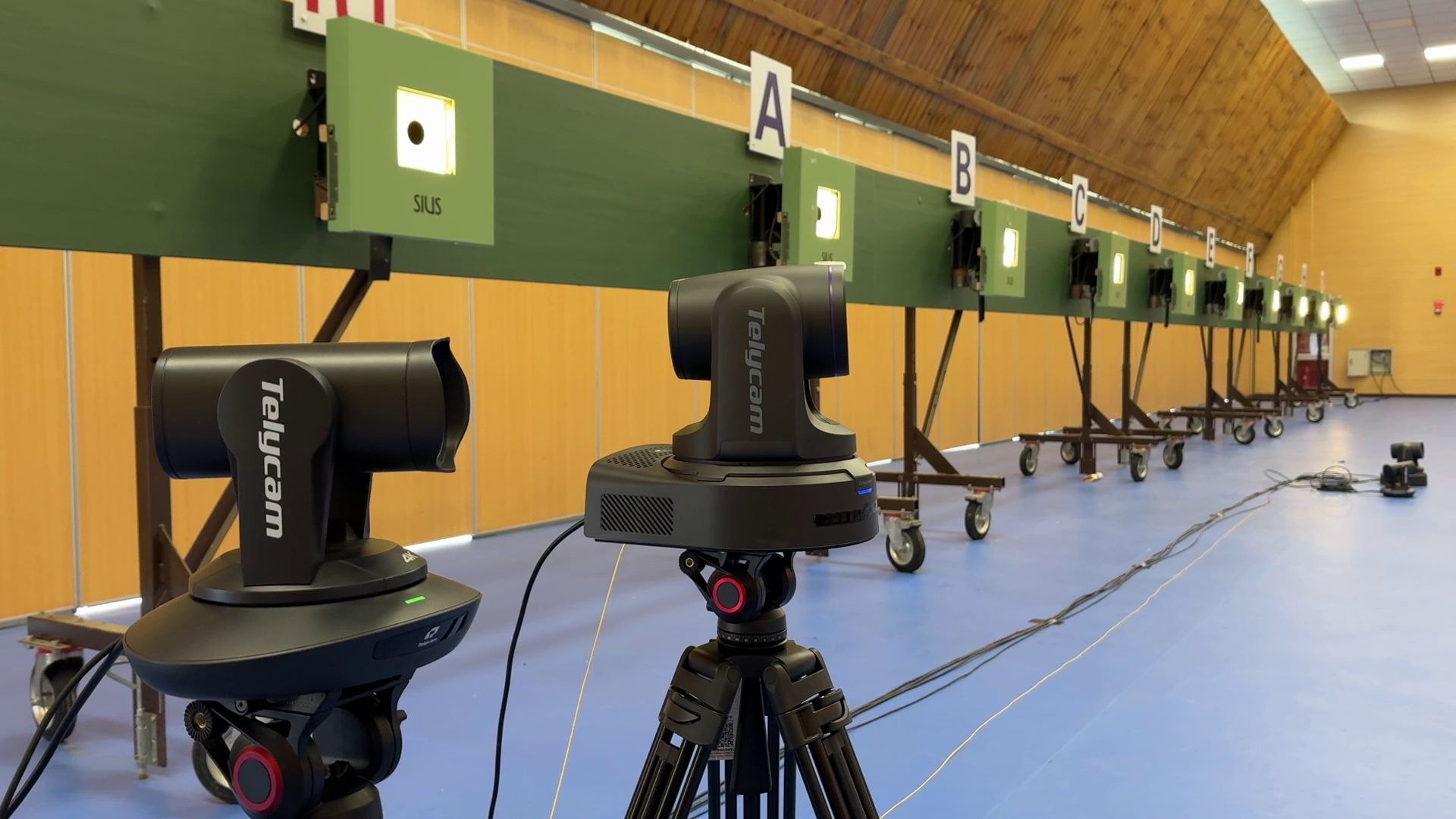
These limits are workable in a studio or conference room. They become a real constraint the moment a production scales up — a camera on the far end of a stadium, a PTZ unit mounted at the back of a large auditorium, or a signal that needs to travel between buildings on a campus. At those distances, copper runs out of range before the signal reaches its destination.
The conventional workaround is a signal repeater — a device placed mid-run that receives the degraded signal, amplifies it, and sends it on. This works, but it adds hardware, introduces another potential failure point, and in the case of 12G-SDI, requires a repeater rated for that specific data rate. For long or complex runs, the repeater chain becomes its own infrastructure problem.
Fiber optic cable solves this differently — not by amplifying the signal mid-run, but by using a transmission medium where attenuation is so low that the signal arrives intact over distances that copper cannot approach.
What Is an SFP+ Port?
An SFP+ port — short for Small Form-factor Pluggable Plus — is a standardized, hot-swappable interface slot found on professional cameras, switches, and video equipment that accepts interchangeable transceiver modules for video or data transmission.
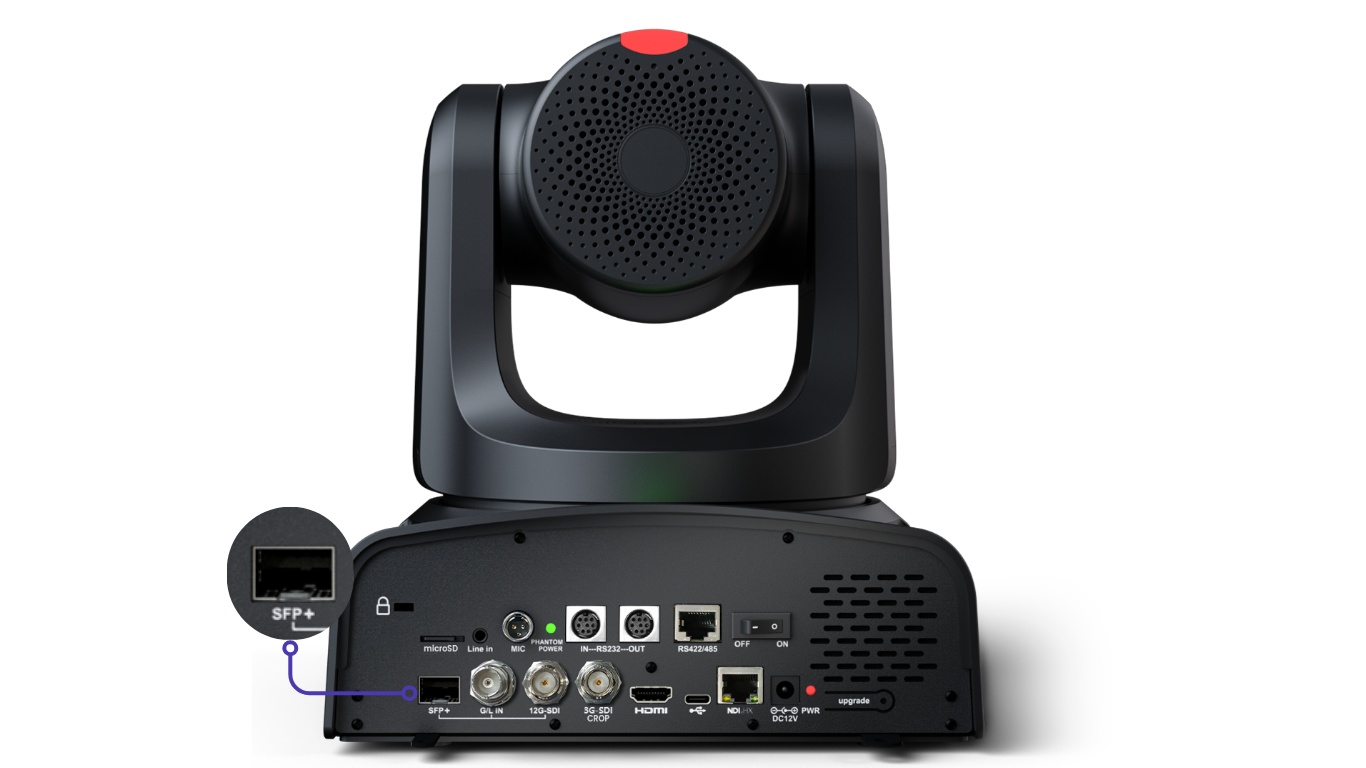
If that definition sounds technical, here's a simpler way to think about it. An SFP+ port is like an empty socket on your camera — a standardized slot that doesn't do anything on its own. What you plug into it determines how the signal travels. Insert a copper module and you get a short-range electrical connection. Insert a multimode fiber module and you get reliable transmission up to several hundred meters. Insert a single-mode fiber module and you can send video several kilometers without signal loss. Same port, completely different capability depending on the module.
This is the fundamental difference between SFP+ and a fixed video output like a BNC or HDMI connector. A BNC port is always a BNC port — it carries an electrical signal over copper, and that's the only thing it does. An SFP+ port is a platform. The module you choose determines the transmission medium, the distance, and the signal type.
In the context of a professional PTZ camera, this modularity has a direct practical benefit: the camera can be deployed in a standard studio setup using a copper SFP+ module for short runs, then redeployed in a large venue using a fiber module for long-distance transmission — without any external conversion hardware, without additional boxes in the signal chain, and without changing the camera's physical connection to the switcher or router it feeds into.
How Fiber Optic Transmission Works
Understanding why fiber optic cables can carry video signals so much further than copper comes down to one basic difference: copper cables carry electricity, and fiber optic cables carry light.
Electricity vs. Light: Why It Matters
When a video signal travels through a copper cable, it moves as electrical current. Electrical current naturally loses strength as it travels — the longer the cable, the weaker the signal gets. This is the attenuation problem described in the previous section, and it's the reason every copper connection has a practical distance limit.
Fiber optic cables work differently. Instead of carrying electrical current, they carry pulses of light through a thin strand of glass or plastic — roughly the diameter of a human hair. The video signal is converted into light at one end, travels through the fiber, and is converted back into an electrical signal at the other end. Because light in a glass fiber loses far less energy over distance than electrical current loses in copper, the signal arrives much further down the line with far less degradation.

Two Additional Advantages
No electromagnetic interference
Electrical signals in copper cables can be disrupted by nearby electrical equipment, power lines, motors, and other sources of electromagnetic interference. Light signals are immune to this entirely. In environments like sports stadiums, concert venues, hospitals, or industrial facilities — where large amounts of electrical equipment operate simultaneously — fiber optic cables maintain signal integrity where copper would struggle.
Electrical isolation
Because fiber carries light rather than electricity, there is no electrical connection between the two ends of a fiber cable. This eliminates ground loop problems — a common source of image noise in copper-based video systems where equipment at different points in a building runs at slightly different electrical potentials.
Single-Mode vs. Multimode Fiber
Not all fiber optic cable is the same. There are two main types, and the difference between them affects how far the signal can travel:
Multimode fiber has a wider core — typically 50 or 62.5 microns in diameter — which allows light to travel through it along multiple paths simultaneously. This makes it less expensive to manufacture and easier to work with, but it also means the light pulses spread out slightly over distance, which limits reliable transmission to around 300–550 meters depending on the cable and module specifications.
Single-mode fiber has a much narrower core — typically 9 microns — which forces light to travel in a single straight path. This dramatically reduces signal degradation over distance, allowing reliable transmission of 2km, 10km, 20km, or even further depending on the module used. Single-mode fiber is the standard for any installation where the camera and the control room are in different buildings, or where cable runs extend across a large outdoor venue.
Multimode fiber
Core Size:50-62.5 microns
Max Distance:300m - 400m
Light Source:LED / VCSEL
Single-mode Fiber
Core Size:9 microns
Max Distance:10km - 40km+
Light Source:Laser
For most permanent installations in large venues, single-mode fiber is the practical choice — the cable itself is inexpensive, and the distance flexibility it provides is worth the slightly higher cost of single-mode SFP+ modules.
SFP+ Modules: Choosing the Right Fiber Solution for Live Production
An SFP+ port provides production systems with great flexibility, but the port itself is only the starting point. The actual transmission performance depends entirely on the SFP+ module installed.
Different SFP+ modules support different transmission media, distances, and use cases. The key is not to choose the “most powerful” option, but to select the module that best matches your physical layout, distance requirements, and budget.
The Main Types of SFP+ Modules
Copper SFP+ modules (DAC cables)
These modules use a short copper cable rather than fiber, and are designed for connections within a rack or between devices sitting very close together — typically 1 to 10 meters. In video production, they work well for connecting equipment inside a control room or broadcast rack, such as linking a switcher to a router or network storage. One important limitation: DAC cables do not support PoE (Power over Ethernet), so they cannot be used to power a camera at the other end. For camera connections specifically, even over short distances, most engineers use standard network cable instead — which supports PoE and is more flexible in the field.
Multimode fiber modules
These modules use multimode fiber cable and operate at an 850nm wavelength, supporting transmission distances of around 300 to 550 meters. They are a practical choice for large indoor venues — a university auditorium, a conference center, or a mid-sized sports arena — where the camera and control room are in the same building but beyond the range of copper. Multimode modules are generally less expensive than single-mode equivalents, making them cost-effective for shorter long-distance runs.
Single-mode fiber modules
These modules use single-mode fiber cable and operate at 1310nm or 1550nm wavelengths, supporting much longer distances — available in 2km, 10km, 20km, and 40km variants. Single-mode is the right choice when cameras and the control room are in different buildings, when cable runs cross outdoor spaces, or when future flexibility in camera placement matters. While single-mode modules cost slightly more than multimode equivalents, the fiber cable itself is actually less expensive than multimode cable — making single-mode the more cost-effective option for longer permanent installations.
DAC (Direct Attach Copper)
Medium: Twinax Copper
Distance: 1m - 7m
Latency: Ultra-Low
Best Use Case: Local Control Room & Rack-to-Rack Patching
Multimode (MMF)
Wavelength: 850nm
Core: 50/125µm (OM3/4)
Distance: Up to 400m – 550m
Best Use Case: Intra-Building & Medium-Scale Venues
Single-Mode (SMF)
Wavelength: 1310nm / 1550nm
Core: 9/125µm (OS2)
Distance: Up to 10km / 40km
Best Use Case: Long-Distance, Cross-Campus & Virtual Production
Three Common Mistakes
01
Mismatching modules at each end
Both ends of a fiber connection must use compatible modules — the same fiber type, the same operating wavelength, and compatible distance ratings. Pairing a single-mode module (1310nm) at the camera with a multimode module (850nm) at the switch will result in no signal, even if both modules physically fit their respective ports.
02
Choosing the wrong distance rating
SFP+ modules are rated for specific maximum distances. A 2km-rated module used on a 5km run will produce a failed or unreliable connection — the signal degrades before reaching the other end. When specifying modules for a permanent installation, always choose a distance rating that comfortably exceeds the actual cable run to account for any additional losses from connectors and patch panels.
03
Using the wrong fiber cable type
Single-mode modules require single-mode cable, and multimode modules require multimode cable. The two look similar from the outside, but their internal glass cores are not compatible. The industry uses color coding to help distinguish them: multimode fiber is typically orange or aqua, and single-mode fiber is yellow. Mixing them will result in no signal even over a short distance.
SFP+ in Video Production: Real-World Applications
With the technical foundation in place, it's worth looking at where SFP+ fiber transmission actually shows up in professional video production — and why it's become a standard part of broadcast infrastructure rather than a specialist solution.
The 12G-SDI and SFP+ Combination
In professional live production, 12G-SDI is widely used for transmitting uncompressed 4K60 video over coaxial cable. However, copper-based 12G-SDI connections are typically limited to around 45–50 meters, which can become a challenge in large venues, studios, and outdoor productions.
An SFP+ interface provides a flexible way to extend these workflows over fiber. By using a compatible transmission module, cameras with SFP+ connectivity can send professional video signals through fiber links over much longer distances — from hundreds of meters to several kilometers — while maintaining stable signal quality and low latency.
The exact signal format carried through SFP+ depends on the camera’s internal design and supported modules. Some systems use SDI-over-Fiber transmission, while others rely on IP-based video workflows, so module compatibility should always be confirmed before deployment.
For production environments where long-distance signal transport is required, a built-in SFP+ interface can simplify system design by reducing the need for external conversion equipment. Telycam’s Explore SE features a native SFP+ interface, giving production teams a flexible fiber connectivity option for demanding broadcast and live event applications.
Where SFP+ Fiber Makes a Practical Difference
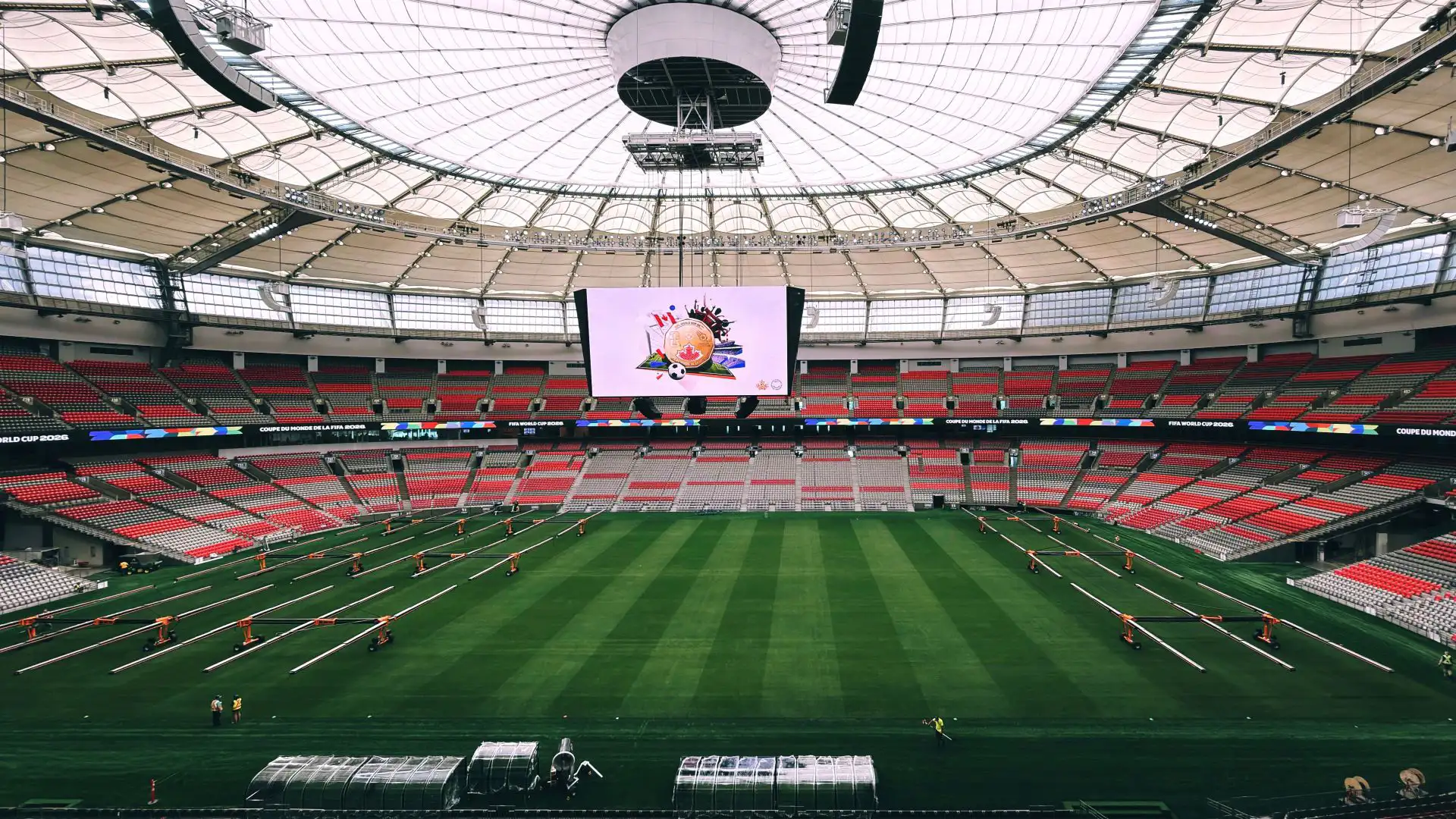
Large sports venues and stadiums
Camera positions in a stadium can be hundreds of meters from the broadcast control room — press boxes, field-level positions, and overhead rigs regularly exceed copper's reliable range. Fiber runs to these positions are standard practice in broadcast venues, and SFP+ modules allow modern PTZ cameras to connect directly into that fiber infrastructure without external conversion boxes.

Outdoor events and festivals
Large outdoor productions involve significant amounts of electrical equipment — stage power, lighting rigs, generator sets — that generate electromagnetic interference capable of disrupting copper cables. Fiber carries light rather than electrical current, making it completely immune to EMI. This physical property makes fiber the reliable choice for outdoor multi-camera setups where cable runs cross areas of high electrical activity.
Healthcare and secure facilities
Hospitals and government facilities present two specific challenges that fiber handles uniquely well. In medical environments, equipment like MRI machines generates powerful electromagnetic fields that can interfere with copper-based video signals — fiber's immunity to EMI makes it the only practical choice in these spaces. In secure government or defense facilities, fiber offers an additional advantage: because it carries no electrical current and emits no electromagnetic radiation, it is significantly more resistant to signal interception than copper, making it the preferred transmission medium where signal security matters.


Multi-building campus and permanent installations
Universities, corporate campuses, and houses of worship with multiple buildings need to share video across distances that copper cannot span without repeaters. Single-mode fiber can cover an entire campus on a single cable run. For permanent installations specifically, fiber infrastructure is a long-term investment — the cable doesn't degrade the way copper can in high-flex or high-humidity environments, and single-mode fiber's distance headroom means the infrastructure remains useful as equipment is upgraded over time.
SFP+ vs. Other Long-Distance Solutions
Conclusion
Distance has always been one of the practical constraints of professional video production. Copper cables are reliable, affordable, and easy to work with — until the run exceeds what the physics of electrical transmission allows. At that point, the choice has traditionally been between accepting the limitation or adding conversion hardware that introduces complexity and potential failure points.
SFP+ ports change that calculation. By building a modular fiber interface directly into the camera, they turn a fixed infrastructure constraint into a flexible deployment decision. The same camera that connects to a switcher over copper in a studio can connect over single-mode fiber across a campus or stadium — by changing the module, not the equipment.
For anyone planning a production environment where cameras need to go further than copper allows — large venues, multi-building campuses, outdoor events, or facilities where electromagnetic interference is a concern — fiber transmission via SFP+ is the cleanest solution available. It carries the signal without compression, without significant latency, and without the signal degradation that distance introduces on copper.
Telycam's Explore SE includes a native SFP+ interface for exactly these deployment scenarios — a built-in option for productions that need fiber flexibility without adding external conversion hardware to the signal chain.