
Genlock Explained
How Multi-Camera Synchronization Works in Traditional and IP-Based Live Production
Multiple cameras are expected to behave like a single system — whether you're producing a live broadcast, a sports event, or a virtual production. But every camera has its own internal clock, and without a way to keep those clocks in sync, even perfectly functioning equipment can fall out of step. That's the problem Genlock was designed to solve.
In this guide, we'll explain what Genlock is, how it synchronizes multiple cameras to a shared timing reference, and why it remains relevant in both traditional SDI workflows and modern IP-based production environments. We'll also cover when Genlock is essential, when it isn't, and how it relates to technologies like NDI and PTP.
Why Cameras Fall Out of Sync: The Root Cause
Before getting into how Genlock works, it helps to understand why the problem exists in the first place.
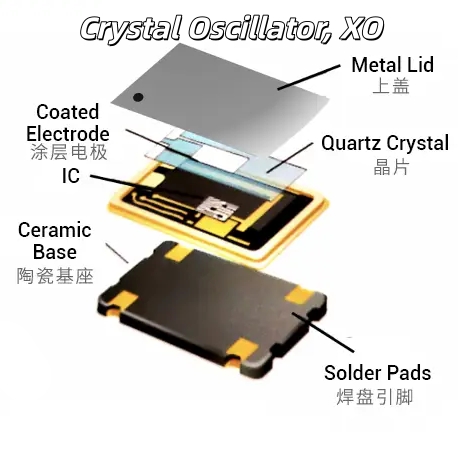
Every camera — regardless of manufacturer or model — has an internal crystal oscillator that drives its video timing. This oscillator determines when each frame starts and ends, and it runs continuously from the moment the camera is powered on. The problem is that no two oscillators are perfectly identical. Even cameras of the same model, produced in the same factory, will have oscillators that run at slightly different rates — differences measured in parts per million, but differences nonetheless.
In a single-camera setup, this doesn't matter. There's only one clock, and everything downstream follows it. In a multi-camera setup, it creates a structural problem. Each camera is running on its own independent clock, and those clocks are not coordinated with each other. Over the course of a broadcast, they drift — slowly but inevitably moving out of phase with one another.
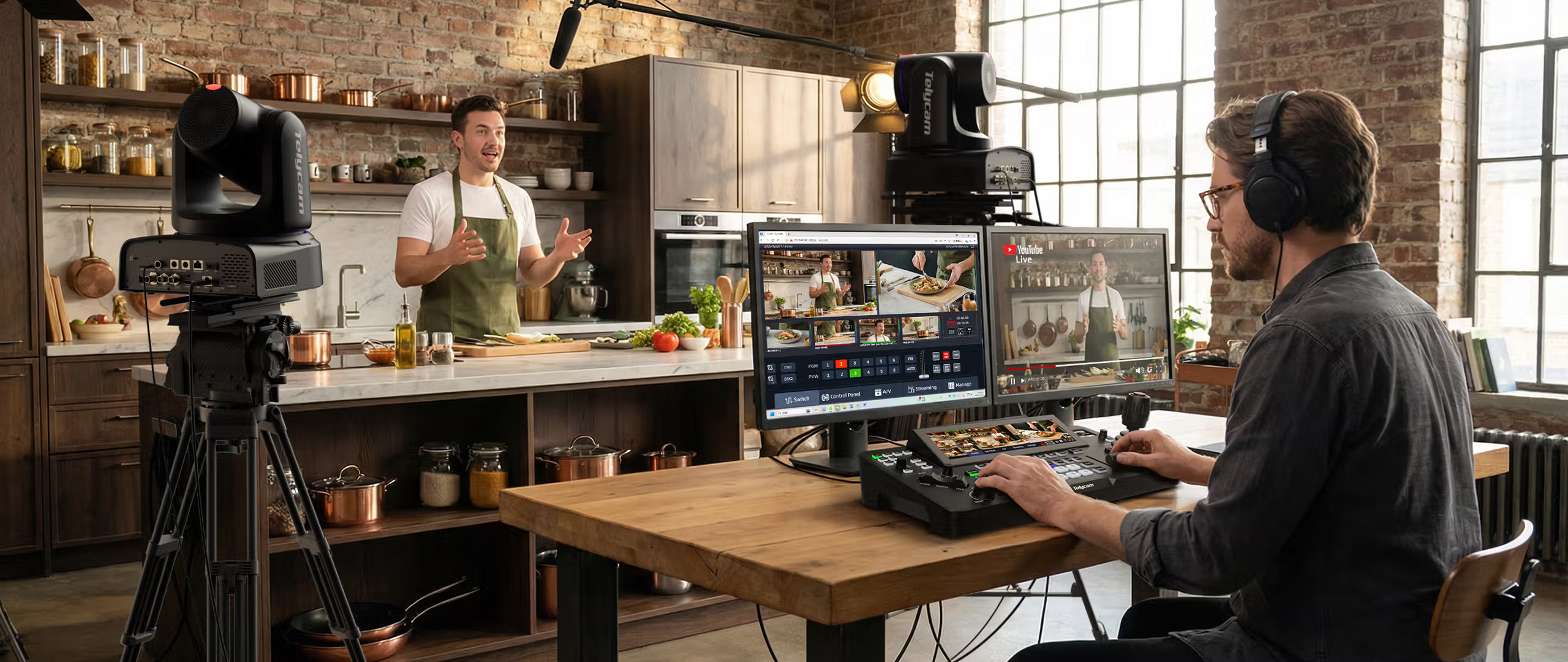
The consequence becomes visible at the moment of a camera cut. A video switcher transitions between sources by selecting a new input at a specific point in time. If Camera 1 and Camera 2 are not synchronized to the same frame boundary — meaning they don't start and end their frames at the same moment — the switcher may capture part of one frame from Camera 1 and part of the next frame from Camera 2 at the moment of transition. The result is a torn image, a flash of visual noise, or a brief color artifact at the cut point.
This is not a malfunction. It is the expected behavior of unsynchronized video sources. Genlock addresses it by giving every device in the system a single shared timing reference to lock onto — eliminating the independent clocks problem at its source.
What Is Genlock?
Genlock — short for Generator Locking — is a broadcast synchronization technology that locks all video devices in a production system to a single shared timing reference signal, ensuring every camera and device starts and ends each frame at exactly the same moment.
In practice, this means that instead of each camera running on its own independent internal clock, every device in the system receives a master reference signal and adjusts its timing to match. The result is a production where any camera can be cut to at any moment without the timing mismatches that cause visual artifacts at the transition point.
Think of it like an orchestra. If every musician plays to their own internal sense of rhythm, the notes may be individually correct but collectively out of time. A conductor gives everyone a shared beat to follow. In a video production system, the sync generator — or a designated master camera — plays the role of that conductor, and every other device locks its timing to that beat.
The master timing signal can come from a dedicated sync generator, a piece of hardware whose sole job is to produce a stable reference, or from a designated master camera that distributes its own timing to the rest of the system.
The Two Reference Signal Types
Not all Genlock signals are the same. Two formats are in common use, and which one applies depends on the resolution of your production:
Black Burst is the older of the two standards, originating in the analog broadcast era. It carries a composite sync signal used to align standard-definition video devices. Despite its age, Black Burst remains in widespread use in facilities that still operate legacy SD equipment or hybrid SD/HD environments where backward compatibility matters.
Tri-Level Sync is the standard for high-definition and ultra-high-definition production. It operates at a higher frequency than Black Burst, which translates to greater timing precision and lower jitter — both important factors when synchronizing cameras at 1080p, 4K, or higher frame rates. Most modern professional cameras, including PTZ cameras designed for broadcast use, accept Tri-Level Sync as their Genlock reference input.
Genlock vs. Frame Sync vs. Timecode:
What's the Difference?
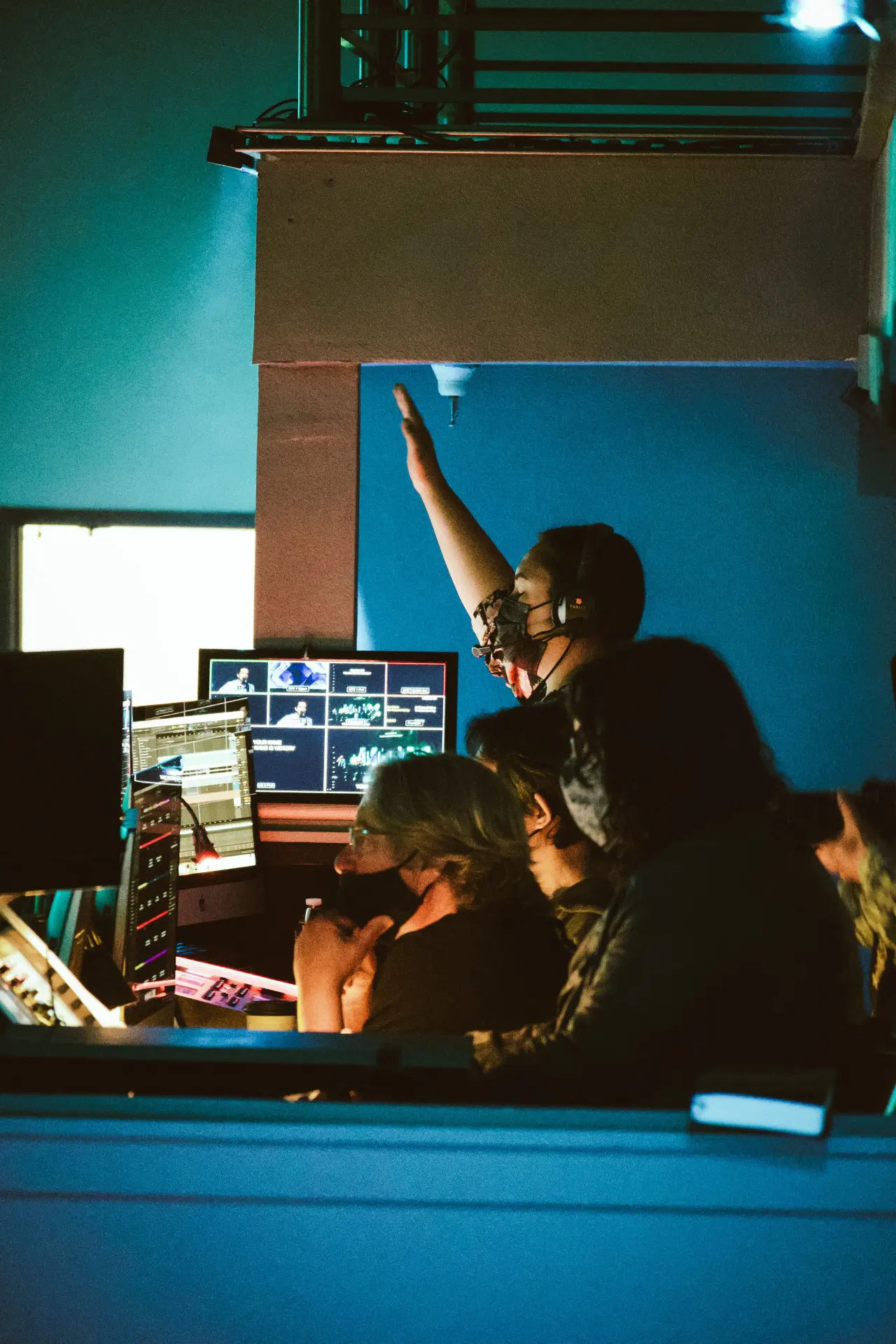
These three terms appear regularly in multi-camera production discussions, and they are frequently confused with one another — sometimes used interchangeably when they shouldn't be. Each one addresses a different aspect of the synchronization problem, and understanding the distinction between them changes how you approach a production setup.
Genlock: Preventive Synchronization
Genlock operates at the source. It locks every device's internal clock to a shared reference before any video is captured, ensuring that all cameras start each frame at exactly the same moment. The synchronization is continuous and real-time — as long as every device remains locked to the reference signal, the system stays in sync frame by frame throughout the entire production.
Core Mode: Hardware-Level
The Proactive Approach
"It prevents timing mismatches from occurring in the first place, rather than correcting them after the fact."
The key characteristic of Genlock is that it is proactive. It prevents timing mismatches from occurring in the first place, rather than correcting them after the fact. This is why it is the preferred method when physical infrastructure allows — it eliminates the problem at its source.
Frame Sync: Corrective Synchronization
A frame synchronizer — often called a frame sync — takes a different approach. Rather than locking the source device to a reference, it accepts an incoming signal that is already out of sync and corrects it at the receiving end by buffering the signal and re-timing it to match the local reference.
Core Mode: Buffer-Based
Handling Remote Feeds
Introduces 1-2 frames of latency to correct timing mismatches reactively. Essential for remote production where physical reference cables aren't feasible.
Frame sync is reactive. It doesn't prevent the timing mismatch — it receives a misaligned signal and fixes it before it reaches the switcher. The tradeoff is latency: buffering and re-timing a signal introduces a delay of one to two frames, which may be acceptable for some production scenarios but problematic for others, particularly where real-time monitoring or talent IFB feeds are involved.
Frame sync is the standard solution when Genlock isn't possible — most commonly in remote production, where cameras are in different physical locations and running a Genlock reference cable between them is not an option.
Timecode: Not Sync, But Reference
Timecode is frequently mentioned alongside Genlock and frame sync, but it serves a fundamentally different purpose. Timecode doesn't synchronize devices in real time — it labels each frame with a timestamp, typically in hours, minutes, seconds, and frames (HH:MM:SS:FF).
Core Mode: Metadata Identification
The Post-Production Solution
Solves alignment problems on the timeline. Ensures multi-camera edits can be perfectly matched after the shoot.
In live production, timecode is used to correlate what happened at a specific moment across multiple recording devices — useful for post-production editing, replay systems, and logging. In a multi-camera setup, timecode ensures that the editor can align footage from different cameras to the correct point in the timeline, even if those cameras were never physically synchronized during the shoot.
The practical distinction is this: Genlock and frame sync solve the real-time switching problem. Timecode solves the post-production alignment problem. They address different stages of the workflow, and in a well-configured production, all three are typically used together.
How the Three Work Together
In an ideal production setup, the relationship between the three looks like this:
Genlock keeps all local devices locked to the same frame boundary in real time
Frame Sync brings any remote or asynchronous sources into alignment at the point of entry into the local system
Timecode is recorded on every source, providing a frame-accurate reference for any post-production work that follows
None of the three replaces the others. Genlock without timecode leaves you with clean live switching but no post-production reference. Timecode without Genlock gives you a post-production tool but no real-time sync. Frame sync without timecode handles the incoming signal but doesn't label it for later use. Together, they form a complete synchronization architecture.
Genlock in Traditional SDI Production
In a traditional SDI production environment, Genlock is not an optional refinement — it is a foundational part of how the system is designed. Every professional SDI facility, from a television broadcast studio to a live event truck, is built around a central timing reference that all devices lock to.
How the Signal Chain Works
The standard configuration starts with a sync generator — a dedicated hardware device whose sole function is to produce a stable, continuous reference signal and distribute it throughout the facility. From the sync generator, the reference signal runs via 75-ohm coaxial cable to every device in the system: cameras, switchers, graphics systems, media servers, monitors, and recording devices. Each device has a Genlock input — typically a BNC connector labeled "Genlock," "Ref In," or "Sync In" — where it receives the reference and locks its internal pixel clock and frame timing to it.
Once every device is locked, the entire system operates on a single shared clock. Frame boundaries are aligned across all sources, and the switcher can transition between any two of them at any moment without producing a timing artifact.
In larger facilities, the reference signal is routed through a distribution amplifier (DA) — a device that takes one reference output and splits it into multiple identical, isolated copies. This ensures that every device receives the same signal at the same voltage and waveform level, regardless of cable run distance.
PTZ Cameras and Genlock in Multi-Camera Deployments
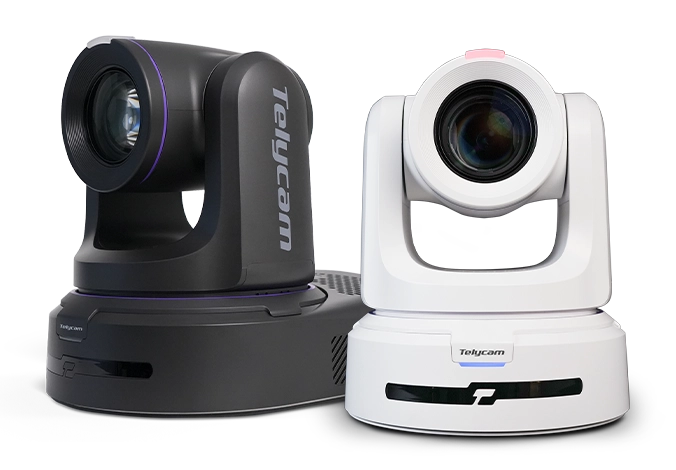
PTZ cameras present a specific advantage in Genlock deployments compared to shoulder-mounted or handheld cameras: they are fixed installations. Because a PTZ camera stays in one place, running a Genlock reference cable to it is a one-time infrastructure decision rather than an ongoing operational challenge. Once the cable is run and the camera is locked, it stays locked for every subsequent production in that space.
This makes PTZ-based multi-camera setups particularly well suited to permanent Genlock configurations — houses of worship, conference centers, broadcast studios, and university lecture theaters where the same camera positions are used repeatedly.
Telycam's Explore and Explore SE both include native Genlock input support, allowing them to lock directly to a facility's master reference signal without external conversion or additional hardware.
Genlock in IP and NDI-Based Production
Traditional Genlock solves the synchronization problem in SDI environments cleanly and reliably — but it relies on physical reference cables running to every device in the system. As production workflows move toward IP-based video transport, maintaining that dedicated physical infrastructure becomes harder, and in some scenarios, impossible. A camera at a remote location, a graphics system running on a software platform, or a virtual production environment built around real-time rendering can't always accept a coaxial Genlock signal. This is where IP-based synchronization approaches come in — and where the relationship between Genlock and newer protocols becomes important to understand.
The Core Challenge: IP Networks Don't Carry Native Sync
In an SDI system, the Genlock reference signal travels on a dedicated coaxial cable, completely separate from the video signal itself. Every device gets a direct, physical connection to the timing reference.
IP networks don't work this way. Video, audio, control data, and timing information all share the same network infrastructure. Standard ethernet networks are inherently asynchronous — packets arrive with variable delays depending on network load, switch processing time, and routing decisions. There is no equivalent of a Black Burst or Tri-Level Sync signal that can simply be distributed over a standard IP network.
This means traditional hardware Genlock cannot be directly applied in a pure IP environment. A different approach is required.
PTP: The IP World's Answer to Genlock
The broadcast industry's solution is PTP — Precision Time Protocol, standardized as IEEE 1588 and adopted into broadcast workflows through SMPTE ST 2059. PTP distributes a highly accurate time reference across an IP network, allowing all connected devices to synchronize their internal clocks to a shared time base — functionally achieving what Genlock achieves in SDI environments, but over standard network infrastructure.
In a PTP system, a grandmaster clock — a hardware device with a highly stable oscillator, often GPS-referenced — distributes timing packets across the network. Connected devices receive these packets and adjust their internal clocks accordingly, achieving synchronization accuracy in the sub-microsecond range. SMPTE ST 2110, the professional IP video transport standard used in high-end broadcast facilities, uses PTP as its timing backbone — meaning that in a full ST 2110 environment, traditional Genlock is effectively replaced by PTP entirely.
NDI Workflows and the Hardware Synchronization Reality
NDI — widely used in corporate, educational, and mid-tier live production — takes a different approach. NDI does not use PTP for timing. Instead, it includes a software-based Genlock API that allows NDI-capable software applications to use an incoming NDI stream as their timing reference.
This works well for purely software-defined sources. Graphics engines, virtual sets, title generators, and replay software can all lock their output to an incoming NDI signal — keeping overlays and digital assets aligned with the main program feed without requiring a physical sync cable.
However, there is a critical limitation: NDI software Genlock only applies to software-defined sources.
Hardware cameras — including PTZ cameras — process video through onboard hardware with fixed clock timing. A PTZ camera outputting NDI High Bandwidth or NDI|HX3 generates its video based on its own internal hardware oscillator, and that clock cannot be adjusted by a software API. Even in a fully NDI-based production environment, hardware cameras still require a physical reference signal for frame-accurate synchronization across multiple devices.
This is precisely why Telycam's Explore and Explore SE retain dedicated BNC Genlock inputs alongside their NDI High Bandwidth and NDI|HX3 outputs. By feeding a physical Tri-Level Sync reference to the camera while transmitting video over the network, technical directors get the best of both worlds: the streamlined cabling of an IP workflow combined with the frame-accurate synchronization of traditional broadcast Genlock.

Virtual Production: Where Genlock Becomes Critical Again
Virtual production environments — where live cameras are composited against real-time rendered backgrounds on LED volumes or in mixed reality setups — represent one of the most demanding synchronization scenarios in modern production. Here, Genlock is not just about clean switching. It is about maintaining the precise temporal relationship between the physical camera and the virtual world it is capturing.
When a camera moves in front of an LED volume, the rendered background must update in real time to match the camera's new perspective, driven by tracking data delivered via the FreeD protocol. For the composite to look correct, the background frame the camera captures must correspond exactly to the camera's position at that precise moment. If the camera's frame timing is not synchronized to the render engine's output, the result is a virtual background that lags or drifts relative to the camera's actual movement — subtle but immediately noticeable to any attentive viewer.
Genlock eliminates this by locking the camera's frame timing to the same reference as the LED processor and render engine. For cameras like the Telycam Explore — with its 1-inch sensor capturing at broadcast-grade resolution — that frame-level alignment ensures every captured frame corresponds precisely to the rendered output, producing a composite that holds up under the scrutiny of large-screen display.
FAQ
Conclusion
Genlock is one of those technologies that becomes invisible when it's working correctly — and impossible to ignore when it isn't. A clean multi-camera broadcast, a virtual production composite that holds up under scrutiny, a large venue display system where every screen stays in step: none of these happen by accident. They happen because someone made the decision to synchronize the system properly from the start.
The core principle hasn't changed since Genlock was first introduced in broadcast facilities decades ago: every device in a synchronized system needs a shared timing reference, and the earlier in the signal chain that reference is established, the fewer problems appear downstream. What has changed is the environment that principle needs to apply to. SDI facilities, IP networks, NDI workflows, virtual production stages — each requires a different implementation, but the underlying need is the same.
For multi-camera PTZ deployments in particular, Genlock is worth treating as infrastructure rather than an option. Fixed camera positions make the cabling straightforward; the investment is made once and benefits every production that follows in that space. Cameras like the Telycam Explore and Explore SE are built with this in mind — native Genlock inputs that integrate directly into a facility's reference signal chain, whether that's a traditional SDI environment or a hybrid IP workflow where physical sync and network transport need to coexist.
If there's one thing this guide is meant to leave you with, it's this: synchronization problems are almost always cheaper to prevent than to diagnose. The time spent troubleshooting an intermittent artifact on a live broadcast — one that appears inconsistently, resists reproduction, and has no obvious cause — can easily exceed the cost of the Genlock infrastructure that would have prevented it.