

What is NDI® HX3? Complete Guide for PTZ Cameras

NDI® HX3 is quickly becoming a key technology for modern PTZ cameras and IP-based live streaming. It delivers high-quality video with lower bandwidth and low latency—solving one of the biggest challenges in video production today.

But what exactly is NDI HX3, and how is it different from NDI HX2 or Full NDI?

In this guide, we break it down in simple terms and help you understand when and why to use it.

What Is NDI® HX3?

NDI® HX3 is a video-over-IP protocol that delivers high-quality video with significantly reduced bandwidth and low latency, making it ideal for modern live streaming and PTZ camera workflows.

NDI HX3 is often considered the “golden balance” in IP video production—offering a practical mix of performance, efficiency, and affordability.

What Is NDI HX3

Why Video Over IP Matters: The Evolution From SDI to NDI HX3

For decades, video production has relied on SDI and HDMI connections. While these technologies are reliable, they come with significant limitations in modern, multi-camera environments.

Each camera requires its own dedicated cable, which quickly leads to complex and expensive setups—especially as systems scale. Distance is another constraint, with SDI typically limited to around 100–300 meters without additional equipment. Installation and maintenance costs also add up, as every connection point introduces potential points of failure.

More importantly, traditional workflows lack flexibility. Expanding a system often means running new cables, adding hardware, and reconfiguring infrastructure—making it difficult to adapt quickly in dynamic production environments.

How NDI Changed Video Production?

Simplified Infrastructure

Replace dedicated SDI cabling with standard Ethernet, carrying video, audio, and control over a single network.

Lower System Costs

Eliminate expensive SDI hardware and reduce installation needs, lowering overall system costs by 30–50%.

Greater Flexibility

Easily add, remove, or reconfigure devices, allowing systems to scale without major infrastructure changes.

Distributed Workflows

Transmit video across rooms or remote locations, enabling flexible and collaborative production over IP networks.

Difference Between Full NDI, NDI® HX2, and NDI® HX3

All three formats—Full NDI, NDI® HX2, and NDI® HX3—are part of the same NDI ecosystem, designed to deliver video over IP networks. The key difference lies in how they balance video quality, bandwidth usage, and latency.

High Bandwidth

Full NDI

The gold standard for quality. Uses minimal compression with ultra-low latency, but requires very high bandwidth.

Compressed

NDI® HX2

Optimized for low bandwidth. Uses heavy compression to reduce network load, with higher latency and lower image quality.

The Sweet Spot

NDI® HX3

The perfect balance. Delivers high-quality video with lower bandwidth and low latency for most production workflows.

Full NDI NDI®HX3 NDI®HX2
Bandwidth (4Kp60)
High (~250Mps)
Medium (~80Mbps)
Low (~12Mbps)
Latency
Very Low≤80ms
Very Low <100ms
Medium≈100ms
GOP
1
1 or 2
60
FPGA
Yes
No
No
Compression format
I-frame Compression
HEVC/H.264
HEVC /H.264

How NDI HX3 Achieves High Quality at Low Bandwidth

The magic of NDI HX3 lies not in a single innovation, but in the intelligent combination of two key technologies: an optimized GOP structure and the elimination of FPGA hardware requirements. Understanding these concepts will help you appreciate why HX3 has become the industry standard for flexible, cost-effective video production.

Understanding GOP (Group of Pictures)

To understand how NDI® HX3 delivers high-quality video at low bandwidth, it’s important to first understand the concept of GOP (Group of Pictures).
In video transmission, data is not sent as a simple continuous stream. Instead, to reduce bandwidth while maintaining image quality, engineers use a structure called GOP.

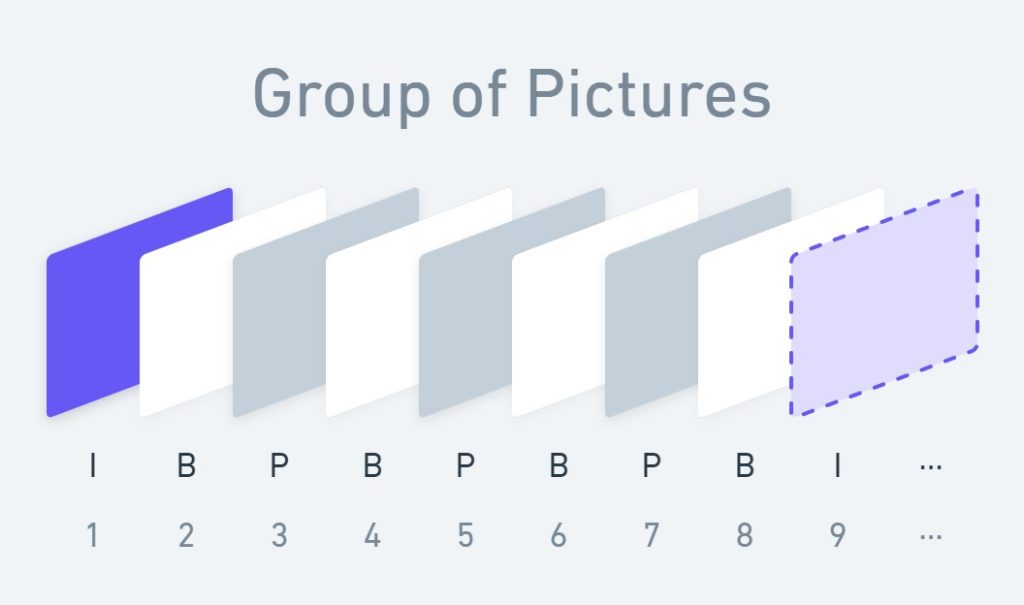
You can think of a GOP as a “video package” that contains multiple related frames working together to represent a sequence of images:

A GOP is defined by the distance between keyframes (I-frames).
For example, a GOP length of 9 means:
1 I-frame + 8 interframes (P-frames and B-frames).

The longer the GOP, the more the video relies on prediction. The shorter the GOP, the more complete frames are preserved.
new-ndihx3-ptz-cameras

Battle of the GOPs: Bandwidth vs Quality

[250Mbps]

Full NDI (GOP 1)
0%

Every frame is a complete keyframe

[80 Mbps]

NDI HX3 (GOP 1-2)
0%

Mostly keyframes with occasional predicted frames

[12 Mbps]

NDI HX2 (GOP 60)
0%

Sparse keyframes, heavy reliance on prediction

Why GOP Length Matters for Live Video

The length of a GOP (the distance between two I-frames) directly affects three key factors: latency, image quality, and bandwidth usage.

Short GOP (more frequent keyframes)
A shorter GOP generates I-frames more often. This reduces reliance on predictive frames (P-frames and B-frames), resulting in:
• Better image quality, especially during motion or scene changes
• Faster recovery when switching between cameras
• Lower end-to-end latency
• Trade-off: Higher bandwidth consumption.

Full NDI represents the extreme of this approach. It is effectively I-frame only (GOP of 1), with every frame being a complete image. This delivers the highest possible visual quality and the lowest latency, but it requires significantly higher bandwidth (typically 150 Mbps+ for 1080p60).

Long GOP (fewer keyframes)
A longer GOP means fewer I-frames, with most frames relying heavily on prediction from previous frames.
Advantages:
• Significantly lower bandwidth usage.
Trade-offs:
• Higher risk of visible compression artifacts during fast motion or camera switches
• Slower recovery from packet loss or network glitches
• Increased overall latency (the decoder must wait for the next keyframe)

NDI® HX2 follows this long-GOP approach to achieve very low bitrates, but it comes with noticeable compromises in latency and image quality during live switching.

NDI® HX3 takes a balanced approach by combining a short GOP with efficient compression. It delivers much better image quality and lower latency than HX2, while requiring far less bandwidth than Full NDI.This makes NDI HX3 the ideal choice for real-world live production with PTZ cameras—especially in environments where smooth switching, responsiveness, and network efficiency are all critical.

Why NDI HX3 Doesn't Need FPGA?

An FPGA (Field-Programmable Gate Array) is a customizable hardware chip commonly used in high-end video systems. In traditional Full NDI workflows, FPGA is required to process large amounts of uncompressed video data in real time.While FPGA offers high performance and flexibility, it also comes with higher cost, increased power consumption, and more complex system design.

NDI® HX3 takes a different approach by using efficient video compression (H.264/H.265), which allows video processing to run on standard ARM-based processors instead of dedicated FPGA hardware.

This design brings several key advantages:

By shifting from hardware-heavy processing to optimized encoding, HX3 achieves a strong balance of performance, efficiency, and accessibility.

FPGA

High-performance, Power-intensive, Costly

ARM

Efficient, Low-power, Cost-effective

A Practical Advantage for Modern PTZ Cameras

In real-world deployments, this architecture makes a noticeable difference. PTZ cameras built on NDI HX3 and ARM-based platforms operate with lower power requirements compared to Full NDI solutions, making them compatible with standard PoE infrastructure. This eliminates the need for separate power supplies and allows multiple cameras to run from a single network connection—a significant advantage when deploying multi-camera systems.

Telycam’s Vision+ N3 exemplifies this approach, combining NDI HX3 encoding with efficient ARM-based processing to deliver professional broadcast quality while maintaining practical deployment requirements. A multi-camera setup using Vision+ N3 cameras requires less infrastructure overhead than traditional Full NDI alternatives, reducing both installation complexity and total system cost.

Conclusion: Is NDI® HX3 Worth It?

NDI HX3 is worth it for most organizations. If you're deploying multiple cameras, need low latency for interactive streaming, or want to simplify your network infrastructure, HX3 is the practical choice. It delivers broadcast-quality video without the cost and complexity of Full NDI, while offering significantly better quality and lower latency than HX2. The only scenarios where you'd choose differently are single-camera setups willing to pay premium prices for Full NDI, or bandwidth-constrained environments where HX2's efficiency is mandatory. For everything else—churches, schools, events, studios, and professional broadcasts—NDI HX3 has become the standard because it works. It's reliable, affordable, and flexible enough to scale as your needs grow.

Contact Telycam

Sales Inquiries

sales@telycam.com

Call Us

+86-755-33275155