
PDAF vs. CDAF in PTZ Cameras:
Which Autofocus Technology Delivers Better Results?
In live production, focus stability directly affects how audiences perceive content quality. When a PTZ camera hunts back and forth mid-shot—a problem known as focus hunting—the result is blurry footage that no post-production can restore.
The root cause comes down to autofocus technology. There are two approaches used in modern PTZ cameras: CDAF (Contrast Detection Autofocus) finds focus through trial and error, while PDAF (Phase Detection Autofocus) calculates the focal point directly in a single step.
This guide breaks down how each works—and why professional PTZ production is increasingly moving toward PDAF.
Table of Contents
How Autofocus Works in PTZ Cameras?
PTZ camera autofocus has one fundamental job: move the lens to the exact position where light from the subject converges precisely on the image sensor. Every autofocus system must answer two questions—which direction should the lens move, and how far? How different technologies answer these questions determines everything about focus speed, stability, and reliability.
For standard cameras, this is a manageable problem. For PTZ cameras, it’s a significantly harder one.
Extreme zoom ranges compress your margin for error.
At wide angle, a lens might cover a depth of field of several meters. At full telephoto on a 30x PTZ, that same lens may have a depth of field measured in centimeters—where even the smallest focus error becomes immediately visible.
Long shooting distances introduce real-world interference.
PTZ cameras routinely target subjects 50 to 200 meters away, where atmospheric conditions like heat shimmer and low ambient light degrade the image contrast that autofocus systems depend on.
Rapid movement leaves no time to re-acquire focus.
Pan, tilt, and zoom transitions can shift the focal distance dramatically within seconds. In live production, the autofocus system must maintain lock throughout continuous motion—not just after the camera stops.
Professional PTZ deployment adds further requirements.
Continuous Autofocus (CAF), AI-based subject tracking, and focus stability through zoom transitions are all expected in modern PTZ workflows—capabilities that go well beyond what standard autofocus architectures were built to deliver.
These demands explain why the autofocus technology inside a PTZ camera matters more than in almost any other camera category—and why the industry is actively moving away from older approaches.
What Is Contrast Detection Autofocus(CDAF)?
Contrast Detection Autofocus (CDAF) is the oldest and most widely used autofocus method in cameras today. To understand how it works, it helps to start with something familiar: your own eyes.
Human vision is itself contrast-based. When you look at an object, your brain continuously evaluates the sharpness of what you’re seeing and adjusts the lens of your eye—the crystalline lens—until contrast is maximized. You don’t consciously think about this; it simply happens. CDAF works on the same principle, except the camera’s image sensor plays the role of your eye, and a motor drives the lens.
How CDAF Actually Works
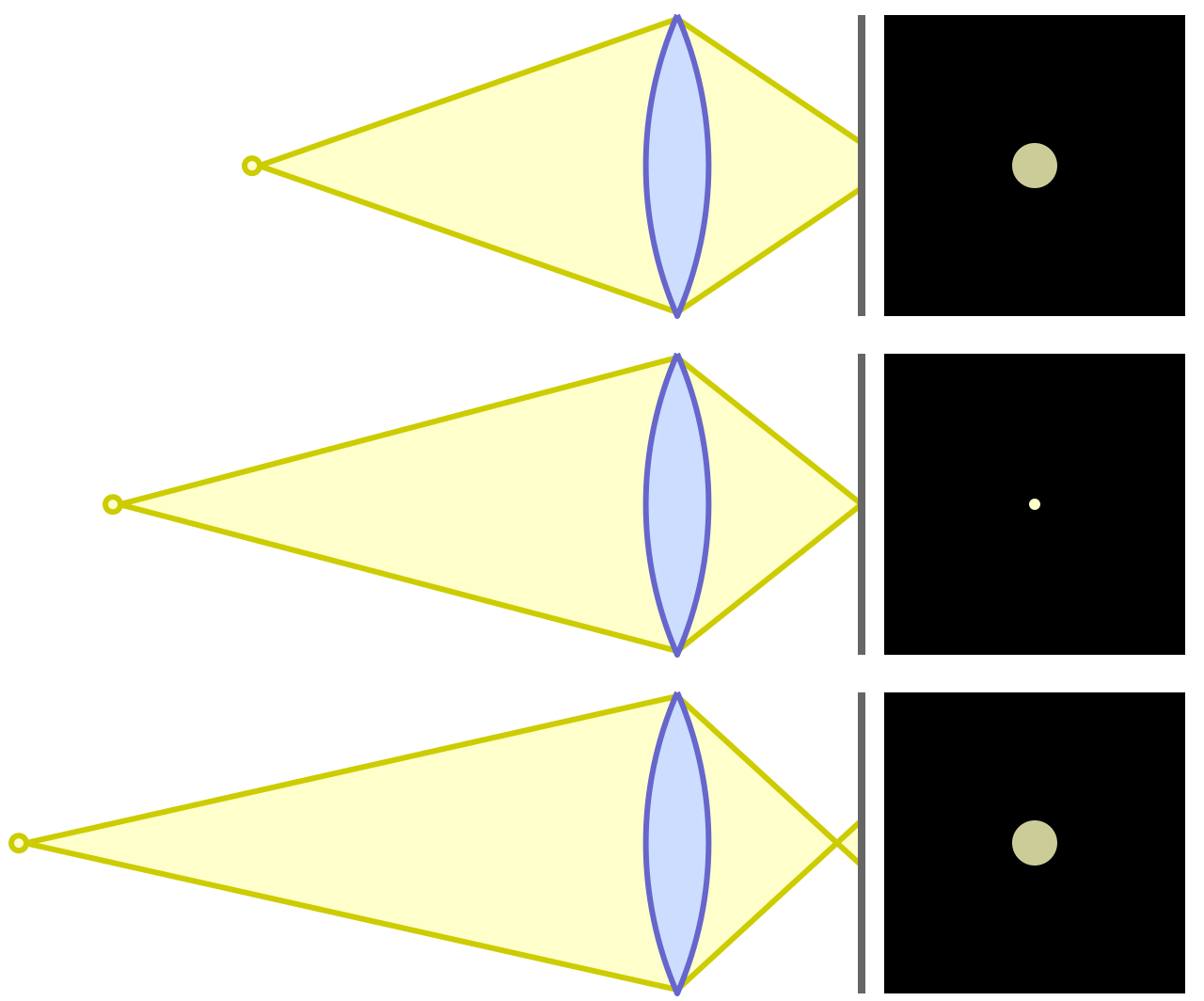
The underlying logic is straightforward. When a lens is out of focus, each point of light from the subject spreads into a small disk on the sensor—called a circle of confusion. Overlapping discs cause adjacent pixels to blur together, pulling contrast down. When focus is correct, those discs collapse back into sharp points, edges become crisp, and contrast peaks.
*Diagram showing circles of confusion for point source too close, in focus, and too far
To find that peak, the camera isolates a zone within the frame—the AF comparison range—and drives the lens through positions one by one, calculating a contrast value at each step. Think of it like slowly turning a radio dial: the signal gets stronger as you approach the right frequency, and you stop when it’s clearest. The camera does the same, locking focus when the contrast value hits its maximum.
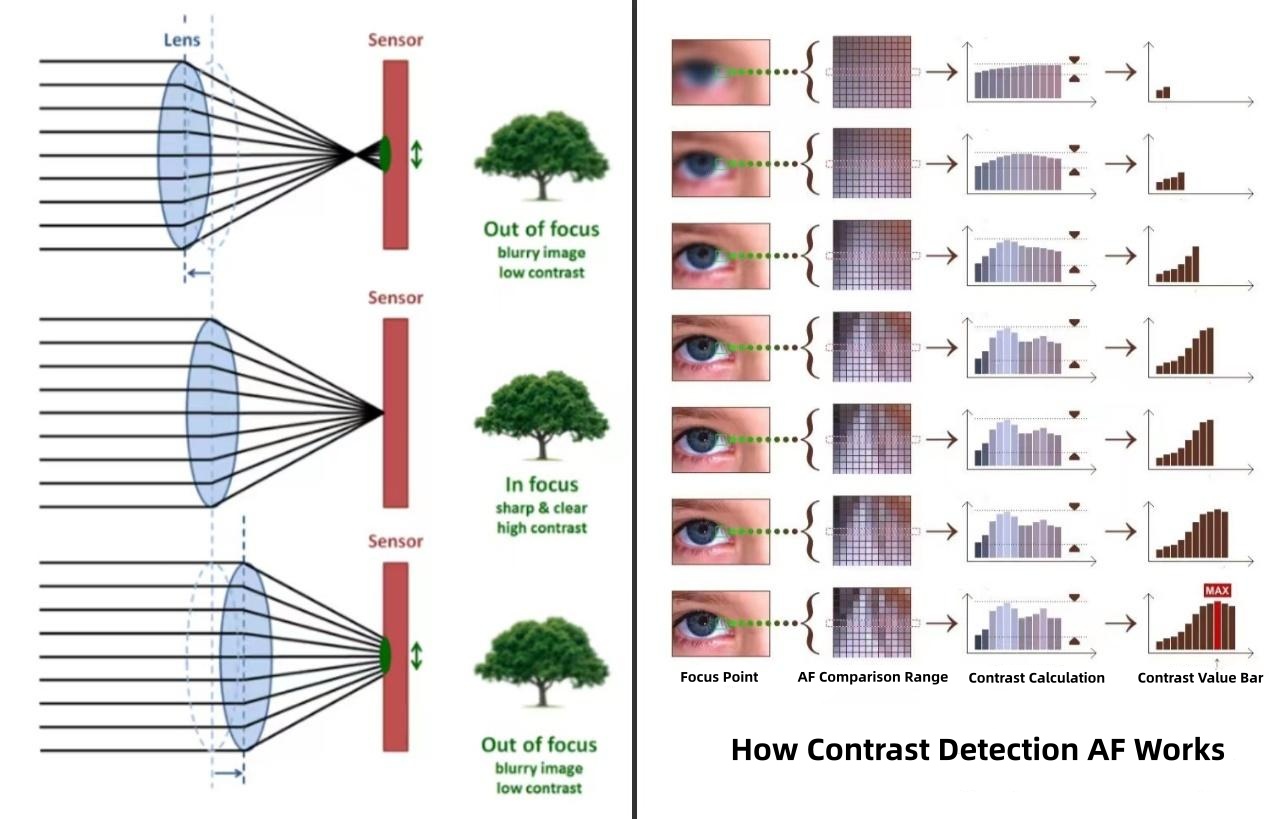
The catch is that the camera can only identify the peak after passing through it. Every time the scene changes, the sweep restarts from scratch, the lens overshoots, then drives back—producing the back-and-forth oscillation viewers see on screen, commonly known as focus hunting.
What Is Phase Detection Autofocus(PDAF)?
Interestingly, Phase Detection Autofocus (PDAF) also has a connection to human vision—but a different one. Rather than mimicking how the eye adjusts focus, it mirrors how the brain determines distance.
Because your two eyes are positioned slightly apart, each captures the world from a marginally different angle. Your brain compares these two slightly offset images and uses the difference—the parallax—to calculate how far away an object is. This is why closing one eye makes depth perception noticeably harder. PDAF applies exactly this logic to autofocus.
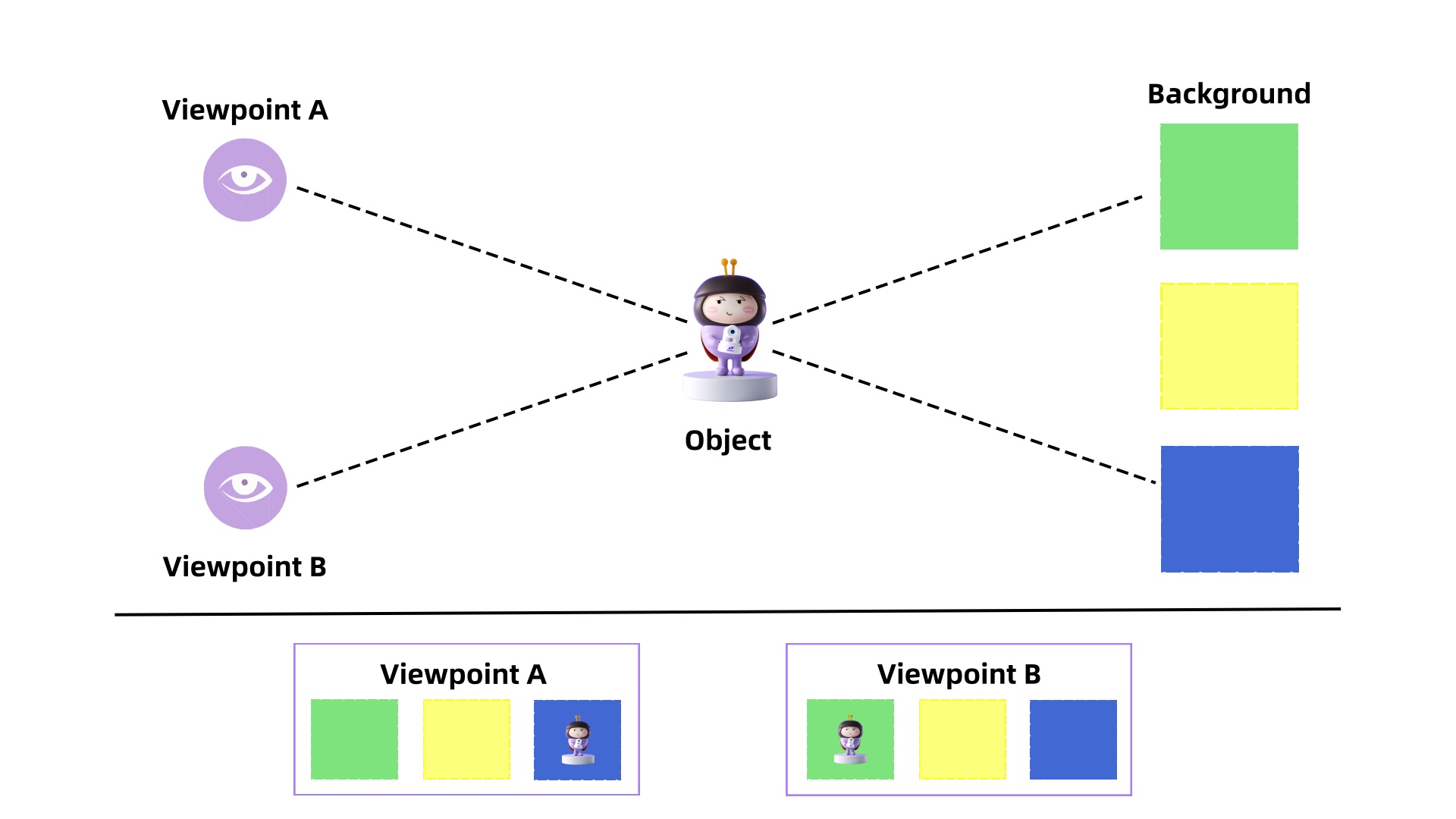
How PDAF Works
Instead of searching back and forth to find the sharpest image, PDAF determines focus in a more direct and calculated way.
Inside the image sensor, there are specially designed pixel pairs—often referred to as phase detection pixels. These pixels are partially masked so that each one receives light from only one side of the lens, either left or right.
As a result, the camera effectively captures two slightly different versions of the same scene at the same time.
When the image is out of focus, these two versions do not perfectly align. By analyzing how far they are offset—and in which direction—the camera can instantly determine:
- The direction the lens needs to move
- The exact distance required to achieve focus
This allows the lens to move directly to the correct position in a single step, rather than relying on repeated adjustments.
You can think of it like a rangefinder. Instead of moving step by step to “find” the correct distance, you measure it once and go straight to the answer.
Because of this, PDAF is able to achieve focus quickly and with high consistency, making it particularly well-suited for real-time applications such as live streaming, broadcasting, and event capture.
*PDAF performance demonstration video
PDAF vs. CDAF — Head-to-Head
After understanding how both autofocus systems work, the next logical question is simple:
How do PDAF and CDAF actually compare in real-world use?
While both technologies are capable of achieving accurate focus, they differ significantly in how they get there—and that difference directly impacts performance in practical scenarios.
| Feature | PDAF (Phase Detection Autofocus) | CDAF (Contrast Detection Autofocus) |
|---|---|---|
| Focusing Speed | Very fast; calculates focus in one movement | Slower; requires iterative adjustments |
| Focusing Accuracy | High, especially for initial focus acquisition | Very high when locked, especially in static scenes |
| Focus Stability | Stable with minimal visible adjustments | Can exhibit visible “focus hunting” |
| Motion Tracking | Strong performance with moving subjects | Limited; struggles with continuous tracking |
| Low-Light Performance | Can degrade if phase signals are weak | Often more reliable due to contrast evaluation |
| System Complexity | More complex sensor design | Simpler implementation |
| Cost | Typically higher | Generally lower |
| Best Use Cases | Live streaming, sports, events, PTZ cameras | Photography, static scenes, controlled environments |
The key takeaway isn’t that one technology is universally better. CDAF’s precision on static subjects is genuinely useful—in a controlled environment where nothing is moving and lighting is consistent, it locks focus cleanly and accurately. The problem is that PTZ cameras are rarely deployed in those conditions.
The moment a subject moves, a presenter steps closer, or the camera pans to a new position, CDAF’s fundamental limitation becomes visible: it has to start over every time. PDAF doesn’t. That difference—between a system that searches and a system that calculates—is what separates cameras that hunt from cameras that simply stay sharp.
For budget installs and fixed-angle conferencing, CDAF remains a practical and cost-effective choice.
For live broadcasting, event production, and any scenario where the camera and subject are both in motion, PDAF isn’t a premium feature—it’s a baseline requirement.
Cameras like the Telycam Explore and Explore XE are built around this principle, bringing PDAF to PTZ workflows where stable, continuous focus matters most.
FAQ
What factors affect PDAF accuracy?
Several variables influence how well PDAF performs:
- Aperture (f-number): A wider aperture (smaller f-number) improves PDAF accuracy. The shallower depth of field produces larger circles of confusion when out of focus, which means a more detectable phase shift between the left and right pixel pairs.
- Subject distance: PDAF is more accurate at closer distances. The same amount of defocus produces a larger phase shift when the subject is near the camera, making it easier to calculate the correct lens position.
- Exposure time: Exposure time itself doesn’t affect PDAF in theory, but extremely short exposures can introduce excessive image noise, which disrupts the accuracy of the phase shift calculation.
- Subject pattern: Subjects with uniform color or repetitive patterns—like a plain wall or a striped shirt—can reduce PDAF reliability. When there’s no detectable variation in the image, the phase detection pixels have nothing meaningful to compare.
- Subject position in frame: PDAF is most accurate at the center of the frame. Off-axis focus points produce a smaller phase shift for the same degree of defocus, which can reduce precision toward the edges.
- Subject color: On sensors where phase detection pixels are green-filtered, a subject that is predominantly red or blue may not provide enough light to those pixels, reducing detection reliability.
What is focus hunting, and how do I fix it?
Focus hunting is the visible back-and-forth oscillation that occurs when a camera’s autofocus system repeatedly searches for the correct focus position without locking cleanly. It’s most commonly associated with CDAF, which must sweep through lens positions to find the contrast peak.
In PTZ cameras, it typically appears after a pan, tilt, or zoom movement, or when the subject has low contrast. Practical fixes include switching to a camera with PDAF or Hybrid AF, narrowing the AF zone to exclude busy backgrounds, or using One-Push AF in stable scenes rather than continuous autofocus.
Does PDAF work in complete darkness?
No. PDAF still requires light to function—the phase detection pixels need to receive enough light from both sides of the lens to calculate a meaningful shift. In near-zero light conditions, both PDAF and CDAF will struggle or fail entirely. Most cameras address this with an AF assist beam or by switching to infrared-based focusing in low-light modes.
Is PDAF only for still photography?
Not at all—PDAF is actually better suited to video than CDAF. Because it calculates focus directly without hunting, it maintains smooth, continuous focus during motion, which is exactly what video requires. It’s the primary reason professional video cameras and high-end PTZ systems have moved toward PDAF and Hybrid AF.
Which is better—PDAF or OIS?
They solve different problems and aren’t directly comparable. PDAF (Phase Detection Autofocus) controls where the lens focuses. OIS (Optical Image Stabilization) compensates for camera shake to keep the image steady. In a PTZ camera, you’d want both: PDAF for fast, accurate focus, and OIS or electronic stabilization for smooth footage during movement.
When was PDAF introduced?
Phase detection autofocus has its roots in film-era SLR cameras from the 1980s, where it was implemented using a separate AF module behind the mirror. On-sensor PDAF—where phase detection pixels are embedded directly into the image sensor—was introduced around 2009 and became widespread in smartphones and mirrorless cameras through the 2010s. It has since become the standard in professional video and PTZ systems.
Does PDAF in smartphones work the same way as in PTZ cameras?
The underlying principle is the same—both use phase detection pixel pairs to calculate focus direction and distance. The main differences are in implementation and scale. Smartphone PDAF is optimized for close-range subjects, compact sensors, and fast social media use cases. PTZ camera PDAF is engineered for longer shooting distances, wider zoom ranges, and continuous operation in professional broadcast environments—where the demands on speed, stability, and accuracy are significantly higher.
Conclusion
PDAF and CDAF represent two fundamentally different approaches to autofocus. PDAF determines focus through direct calculation, delivering the speed and stability that dynamic scenes demand. CDAF refines focus through contrast analysis, making it a reliable choice where precision matters more than response time.
In practice, the right system comes down to how the camera is used. For live streaming, broadcasting, and PTZ applications where fast, continuous focus is critical, PDAF is the clear answer. For controlled, static environments, CDAF remains a capable and cost-effective solution.
As production workflows move increasingly toward real-time capture, autofocus performance has become one of the most important factors in camera selection—and understanding the difference between these two technologies is the first step to making the right choice.
Contact Telycam
Sales Inquiries
sales@telycam.com
Call Us
+86-755-33275155