
12G-SDI vs. 3G-SDI
Which One Does Your Production Actually Need?
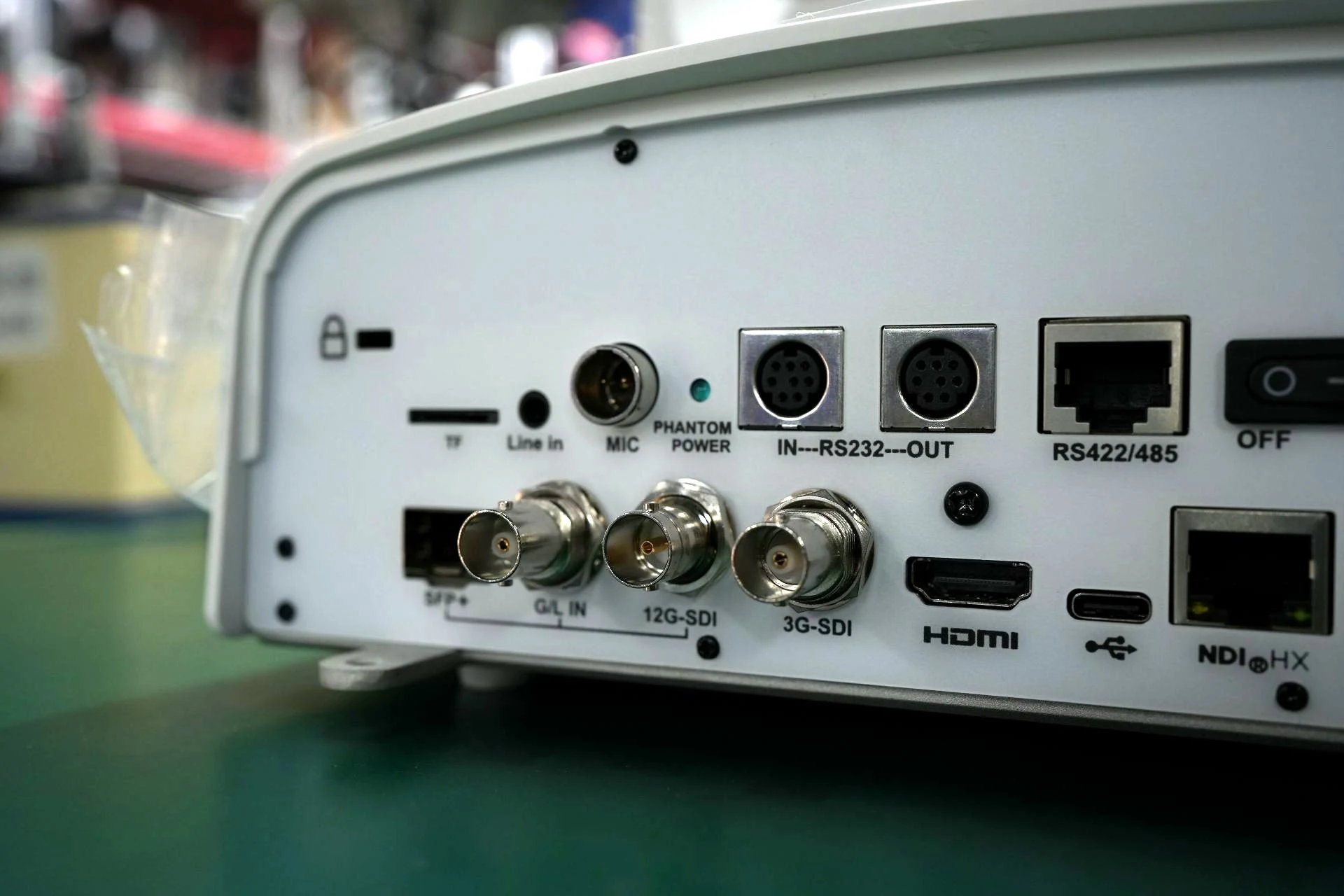
Most professional PTZ cameras and video switchers ship with SDI connections — but not all SDI is the same. Depending on the device, you might see 3G-SDI, 12G-SDI, or both listed in the spec sheet, and the difference between them affects everything from resolution support to how many cables your setup actually needs.
3G-SDI has been the standard for HD production for over a decade. 12G-SDI is the newer standard built specifically for 4K. Both are still widely used today, and choosing between them — or understanding which one your equipment already supports — depends entirely on what your production needs to deliver.
This guide breaks down what each standard actually does, how they compare, and how to decide which one is right for your workflow.
What Is SDI? A Simple Foundation
SDI stands for Serial Digital Interface — a standard for transmitting uncompressed digital video over coaxial cable, developed by SMPTE and first introduced in 1989. It remains the backbone of professional broadcast and live production today, valued for its reliability, long cable runs, and minimal latency compared to consumer alternatives.
SDI is often compared to HDMI and IP-based video transport. HDMI is common in consumer and prosumer setups but has limited cable run distances and lacks the locking connector broadcast environments require. IP-based video (such as NDI) offers flexibility and scalability over standard network infrastructure, but introduces its own considerations around bandwidth and latency. SDI's advantage has always been simplicity and consistency: one cable, one signal, predictable performance.
Since its introduction, SDI has evolved through several generations — each one defined primarily by how much data it can carry. That bandwidth increase is also what separates 3G-SDI from 12G-SDI, and it's the foundation for everything covered in the next two sections.
What Is 3G-SDI? The HD Workhorse
Standardized as SMPTE 424M, 3G-SDI operates at a nominal bitrate of approximately 2.97 Gbps—a bandwidth capacity engineered precisely to transmit a single, uncompressed 1080p60 video signal over a single coaxial cable. For over a decade, this capability has established 3G-SDI as the bedrock infrastructure for high-definition production across broadcast studios, houses of worship, corporate conference spaces, and live streaming environments globally.
The enduring dominance of 3G-SDI stems from three key pillars: reliable performance for standard HD workflows, exceptional cost-efficiency compared to higher-bandwidth routing infrastructure, and an immensely mature hardware ecosystem. Legacy PTZ cameras, production switchers, distribution amplifiers, and monitors support 3G-SDI as a baseline, allowing engineers to scale, modify, and maintain production systems with off-the-shelf components.
However, the bottleneck of 3G-SDI becomes apparent the moment a workflow demands ultra-high-definition video. The 2.97 Gbps ceiling cannot natively transport a 4K (UHD) signal over a single link. Achieving 4K resolution over a 3G-SDI framework requires a workaround known as Quad-Link SDI—splitting the video payload across four separate cables. While this temporarily resolves the bandwidth deficit, it introduces substantial complexities regarding cable management and signal synchronization, which we will analyze in the following section.
What Is 12G-SDI? The Single-Cable 4K Standard
Standardized under SMPTE ST 2082, 12G-SDI operates at a nominal bitrate of approximately 11.88 Gbps—exactly four times the bandwidth capacity of 3G-SDI. This massive pipe allows a single coaxial cable to transmit a full, uncompressed 4K (UHD) video signal at 60 frames per second. This singular capability defines the interface: where legacy 3G-SDI infrastructures require cumbersome Quad-Link configurations to patch together a 4K image, 12G-SDI delivers the identical resolution, frame rate, and color fidelity through a single-link connection.
In practical broadcast engineering, this bandwidth leap yields massive operational advantages. Transitioning to a single-link 12G-SDI ecosystem means utilizing one physical connector per PTZ camera instead of four, streamlining system architecture into a clean, point-to-point infrastructure. By eliminating external hardware-level splitters, combiners, and converters from the signal chain, the risk of technical failure is drastically reduced. For multi-camera environments, this reduction in physical complexity compounds rapidly—resulting in fewer cables to route through cable trays, fewer connection points vulnerable to signal degradation, and zero time wasted troubleshooting phase-alignment or synchronization issues between separate links.
Consequently, 12G-SDI has cemented itself as the definitive interface of choice for high-tier 4K live production, multi-camera broadcasting, and virtual production (XR) environments. It provides the ideal synchronization baseline and zero-latency performance required where high-resolution rendering and operational efficiency must coexist.
12G-SDI vs. 3G-SDI: Core Technical Differences
The most fundamental difference between the two standards is bandwidth: 12G-SDI carries approximately four times the data rate of 3G-SDI. This is what enables a full 4K60p signal to be transmitted over a single cable instead of requiring four links.
Both 3G-SDI and 12G-SDI use the same 75-ohm BNC connectors. However, 12G-SDI demands significantly tighter manufacturing tolerances and better return loss performance due to the much higher frequencies involved — even though the connector form factor is unchanged.
This sensitivity is most evident in achievable cable lengths. Belden 1694A, a widely used broadcast coax originally designed for 3G/6G-SDI, supports spec-compliant runs of around 78 meters at those data rates — though it was never officially rated for 12G-SDI. For 12G-SDI, the industry has moved to purpose-built cables such as Belden's 4794R, which is rated for runs up to roughly 90–130 meters depending on conditions. The underlying rule remains constant: higher frequencies require better-engineered cable to maintain signal integrity over distance.
For longer runs — large studios, arenas, or remote camera positions — the industry standard solution is optical fiber. Using SMPTE-compliant SFP/SFP+ transceivers, 12G-SDI signals can be transmitted over several kilometers with virtually no degradation. This is why modern professional 12G-SDI equipment increasingly offers built-in fiber connectivity options.
Choosing Between 3G-SDI and 12G-SDI
As broadcast technology continues to move toward higher resolutions, infrastructure complexity has become a key bottleneck in production efficiency. Understanding the evolution of SDI standards is not only about bandwidth, but also about how to achieve superior signal integrity within increasingly simplified system architectures.
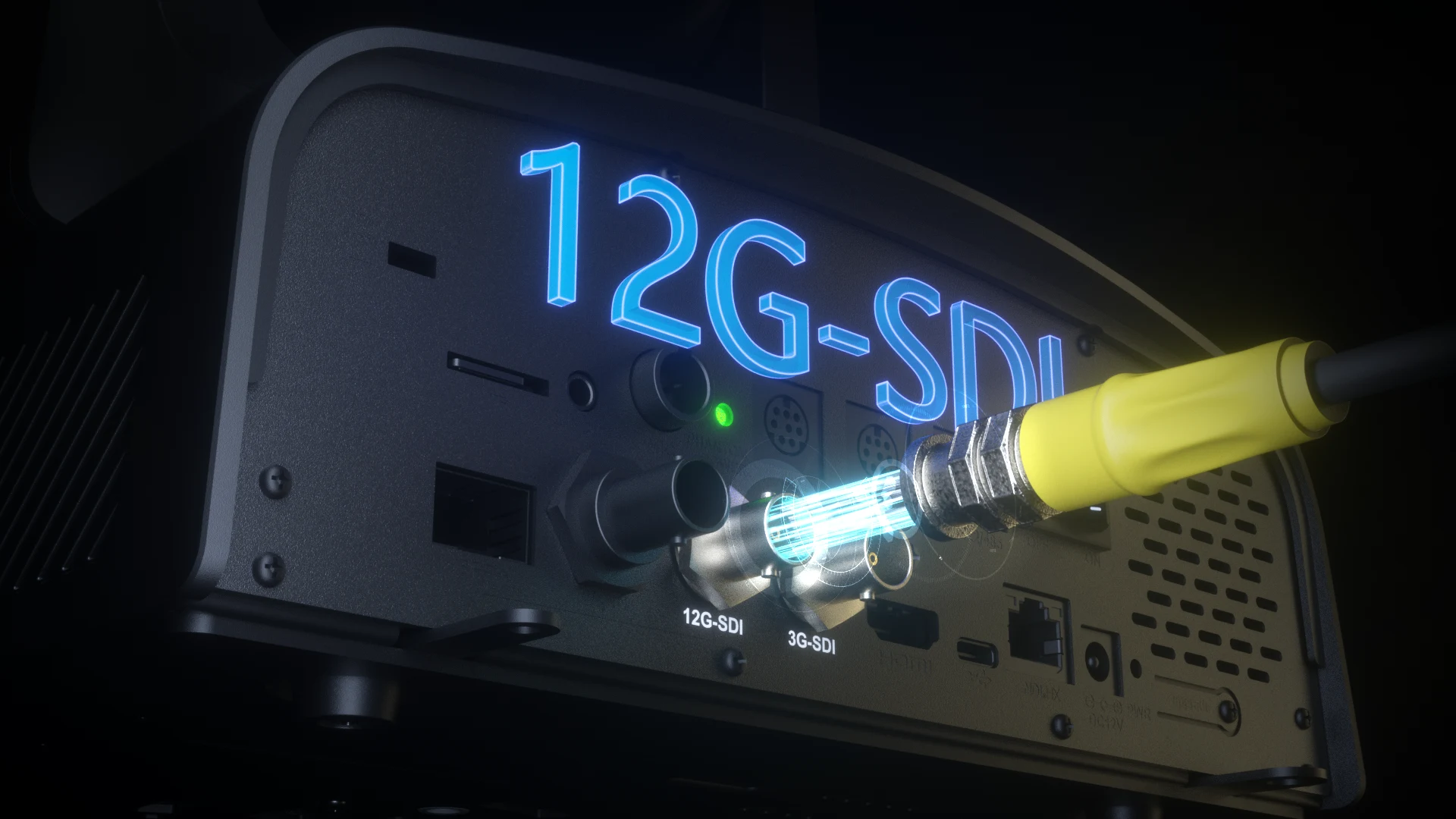
For most production environments, a simple decision rule applies: if your primary goal is to maintain a stable HD (1080p) workflow, 3G-SDI remains the most cost-effective and widely adopted standard.
However, when production requirements move toward 4K (UHD) and prioritize single-cable simplicity, 12G-SDI becomes the more practical infrastructure choice.
Why the Difference Matters in Real Production Systems
On paper, both standards are part of the same SDI ecosystem. In practice, they behave very differently once you scale into multi-camera or 4K environments.
The key difference is how video bandwidth is carried:
3G-SDI Bandwidth Limitations
3G-SDI cannot transport 4K in a single stream, which leads to multi-link (quad-link) configurations
12G-SDI Efficiency
12G-SDI carries 4K over a single coaxial cable, removing the need for signal aggregation
This difference reshapes the physical and operational structure of a production system.
Infrastructure Impact When Moving to 4K
When a workflow moves from HD to 4K, the gap between these two standards becomes very practical:
Cabling complexity
3G-SDI quad-link setups require four synchronized cables per 4K signal. This increases rack space usage, cable weight, and installation complexity.
12G-SDI reduces this to a single cable per signal, significantly simplifying rigging and routing.
Switcher and router capacity
A quad-link 4K signal consumes four SDI inputs or crosspoints.
A 12G-SDI signal consumes only one, effectively multiplying available system capacity.
System scalability
As camera count increases, quad-link complexity grows linearly — or worse, exponentially in management overhead.
12G-SDI maintains a one-to-one relationship between camera and input.
Reliability factors
Multi-link systems introduce more points of failure. A single degraded cable or mismatch in timing can affect the entire 4K image.
Single-link 12G-SDI reduces these failure points by design.
When 3G-SDI is Right
• When HD (1080p) is the final delivery format
• When cost efficiency is a higher priority than resolution scaling
• When existing SDI infrastructure is already stable and fully deployed
• When production complexity needs to stay minimal
When 12G-SDI is Better
• When 4K delivery is required or standardised
• When multiple 4K cameras are used in a single production
• When system simplicity and reduced cabling are priorities
• When working in environments like virtual production or LED volumes, where 4K is often the baseline
Choosing is not just about technology updates; it's about workflow philosophy. 12G-SDI is rapidly becoming the industry standard because it solves 4K complexity with a single cable. However, before upgrading, be sure to evaluate whether your existing cable quality (Return Loss) can handle the strict 12GHz requirements.
FAQ
Conclusion
Choosing between 3G-SDI and 12G-SDI is not really a question of which technology is newer — it's a question of workflow philosophy. 12G-SDI is rapidly becoming the industry standard because it solves 4K's cabling complexity with a single connector, but that doesn't make 3G-SDI obsolete. For HD-based productions, it remains the simpler, more cost-effective standard, and there's no operational reason to move away from it before the workflow actually demands more.
If you are planning to upgrade, the standard itself is only part of the equation. As covered earlier, 12G-SDI's higher frequencies are far less forgiving of cable and connector quality — before committing to an upgrade, it's worth confirming that your existing coax and BNC connectors can actually meet the return-loss performance 12G-SDI requires, rather than assuming any "SDI cable" will do.
Telycam's camera lineup reflects this same range of needs. The Vision and Drive series are built around 3G-SDI for HD production environments where that standard is the right fit, while the Explore and Explore SE support native 12G-SDI for teams moving into 4K — without relying on quad-link cabling or external converters. Whichever standard your workflow calls for, there's a model built around it.